

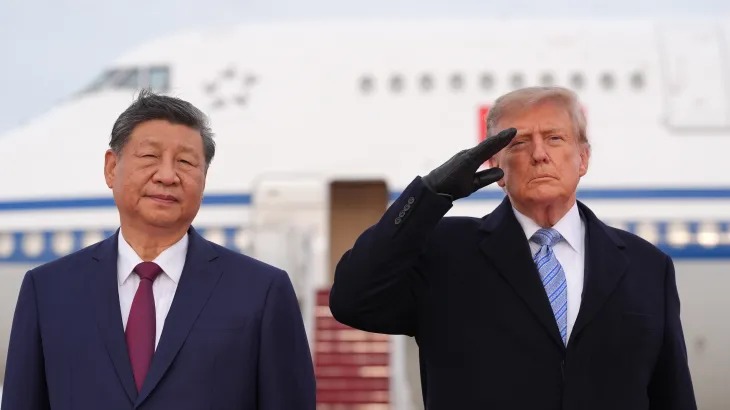
Chinese President Xi Jinping arrived in Washington, DC, on Wednesday for a three-day visit that is expected to shape relations between the world’s two largest economies. United States President Donald Trump personally welcomed Xi as both leaders prepared for talks on trade, artificial intelligence, Taiwan and other major international issues.
Xi landed at Joint Base Andrews outside the US capital, where Trump greeted him in person. The move was seen as a significant diplomatic gesture and highlighted the importance both governments place on their relationship.
The welcome ceremony included military honors, a band performance and formal greetings involving both leaders and their spouses. Trump and Xi spent several minutes speaking before posing for photographs. A military aircraft flyover and ceremonial displays formed part of the reception.
Shortly before Xi’s arrival, the Trump administration announced that the United States and China had agreed to extend their existing trade truce. The agreement, which had been due to expire in November, will now remain in effect until January 10.
The extension gives both countries additional time to negotiate broader trade arrangements and avoid a return to higher tariffs and new trade restrictions. The deal has provided temporary relief after years of economic tensions between Washington and Beijing.
US Treasury Secretary Scott Bessent said discussions with senior Chinese officials helped secure the extension. He indicated that both sides are exploring the possibility of a larger agreement and need more time to work through complex details.
The trade relationship remains one of the most important issues between the two governments. In recent years, both countries have imposed tariffs, export controls and other restrictions that affected global markets and supply chains. While tensions have eased compared with previous years, several key disagreements remain unresolved.
In a statement released after arriving in the United States, Xi emphasized cooperation between the two nations. He said China and the United States should be partners rather than rivals and noted that both countries can benefit from each other’s success.
According to Chinese state media, Xi said China’s national development goals and America’s economic ambitions can progress together and contribute positively to global growth.
The visit follows Trump’s trip to Beijing earlier this year, making 2026 an unusually active period of diplomacy between the two leaders. Analysts say the exchange of visits reflects efforts by both governments to stabilize relations after years of political and economic friction.
Xi’s schedule includes a state dinner, meetings with senior US officials and business leaders, a military ceremony at the White House and a visit to the National Archives. The visit is expected to attract significant attention from political leaders, investors and international observers.
Trade will be a major focus of the talks, but several other issues are also expected to be discussed. These include developments in artificial intelligence, regional security concerns and relations involving Taiwan.
Taiwan remains one of the most sensitive issues in US-China relations. Beijing considers the self-governed island part of its territory, while Washington maintains unofficial ties with Taipei and continues to provide support under existing US policy.
Analysts believe Chinese officials may raise concerns about a proposed US arms package for Taiwan. The issue has been a source of disagreement between the two governments and remains a key topic in bilateral discussions.
Artificial intelligence is also expected to receive significant attention. Both countries are investing heavily in AI technologies, and officials have discussed ways to improve communication on potential security risks linked to advanced systems.
Experts say one possible area of cooperation could involve creating mechanisms that allow both governments to notify each other about serious AI-related security concerns. Such measures could help reduce misunderstandings and improve communication as the technology continues to develop.
Foreign policy analysts noted that the short extension of the trade truce suggests both sides may be working toward a broader agreement. Additional negotiations are expected over the coming months as officials continue discussions on trade, technology and strategic issues.
The meetings between Trump and Xi are being closely watched around the world. The outcome could influence economic policy, technology cooperation and geopolitical stability at a time when both nations play central roles in shaping the global economy.
