

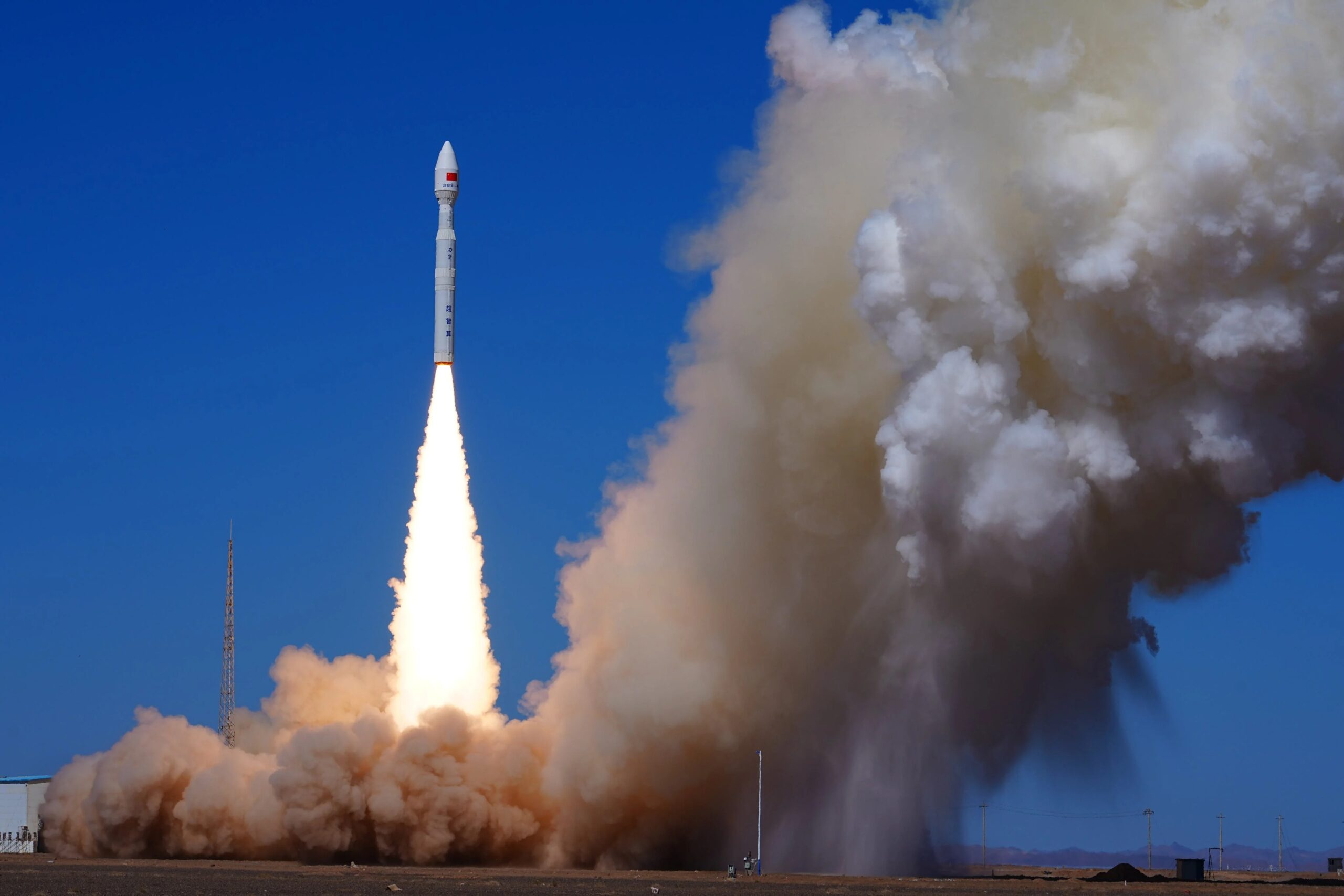
China has taken another step in advancing its space technology with the successful launch of its first commercial radio tracking satellite constellation designed for electronic intelligence missions.
The launch took place on Sunday at the Jiuquan Satellite Launch Centre in northern China. A Lijian-1 Y18 rocket lifted off at noon carrying nine satellites into space.
Among the payload were three Diting-01 satellites, which successfully entered their planned orbit after launch. The satellites are expected to play a key role in monitoring electronic signals and gathering information from a wide range of sources.
The mission has attracted attention because of the capabilities linked to the Diting-01 system.
According to available information, the satellites are designed to detect, locate, and track electronic emissions from targets on land, at sea, and potentially in the air. These signals can come from military radars, communication systems, electronic jamming equipment, and other electronic devices.
The launch marks China’s first commercial deployment of satellites specifically focused on radio tracking and electronic intelligence from space.
The satellites are named after Diting, a mythical creature from Chinese folklore.
In traditional stories, Diting serves as a companion to Ksitigarbha, the bodhisattva associated with the underworld. The creature is believed to possess extraordinary hearing and the ability to identify anything simply by listening.
The name reflects the purpose of the satellites, which are designed to gather information by detecting and analyzing radio signals.
Unlike traditional observation satellites that rely on cameras and optical sensors, radio tracking satellites focus on electronic emissions.
These emissions can reveal the location and activity of military assets even when they are hidden from visual observation.
For example, a warship operating far from shore may be difficult to spot using standard imaging systems. However, the ship’s radar, communications equipment, or other electronic systems may produce signals that can be detected from space.
By analyzing those signals, operators can determine the position and movement of the target.
The same principle can be applied to ground-based radar installations and electronic warfare systems.
Military analysts have increasingly highlighted the importance of electronic intelligence in modern warfare.
As armed forces rely more heavily on communications networks, radar systems, and electronic equipment, the ability to detect and analyze those signals has become a valuable capability.
Space-based systems provide an additional advantage because they can monitor large areas without relying on aircraft or ships operating near potential targets.
The Diting-01 satellites are expected to contribute to this growing area of technology.
The deployment also reflects China’s broader efforts to expand its commercial and military-related space capabilities.
In recent years, the country has launched a large number of satellites for communications, navigation, Earth observation, scientific research, and remote sensing missions.
Commercial space companies have also become increasingly active, helping support a wider range of projects and technologies.
The Lijian-1 rocket used for the mission has become an important part of those efforts.
Known for its ability to carry multiple satellites into orbit during a single launch, the rocket has supported several missions involving commercial and government payloads.
The successful deployment of the Diting-01 satellites demonstrates the continued growth of China’s launch capabilities and satellite industry.
Electronic intelligence satellites are becoming more important worldwide as nations seek better awareness of activities in strategic regions.
Such systems can help monitor shipping routes, military exercises, communication networks, and electronic activity across large distances.
The ability to collect information from space without direct contact with a target makes these satellites valuable tools for surveillance and intelligence gathering.
The Diting-01 mission highlights China’s interest in expanding its presence in this field.
While officials have not released extensive technical details about the satellites, their stated purpose suggests a focus on detecting and locating radio frequency emissions from a variety of sources.
With the satellites now operating in orbit, attention will turn to how effectively the system performs its tracking and monitoring missions.
The launch represents another milestone for China’s space sector and signals continued investment in advanced satellite technologies. As electronic intelligence becomes an increasingly important part of modern security and defense operations, the Diting-01 constellation is expected to play a significant role in China’s future space-based monitoring capabilities.
