

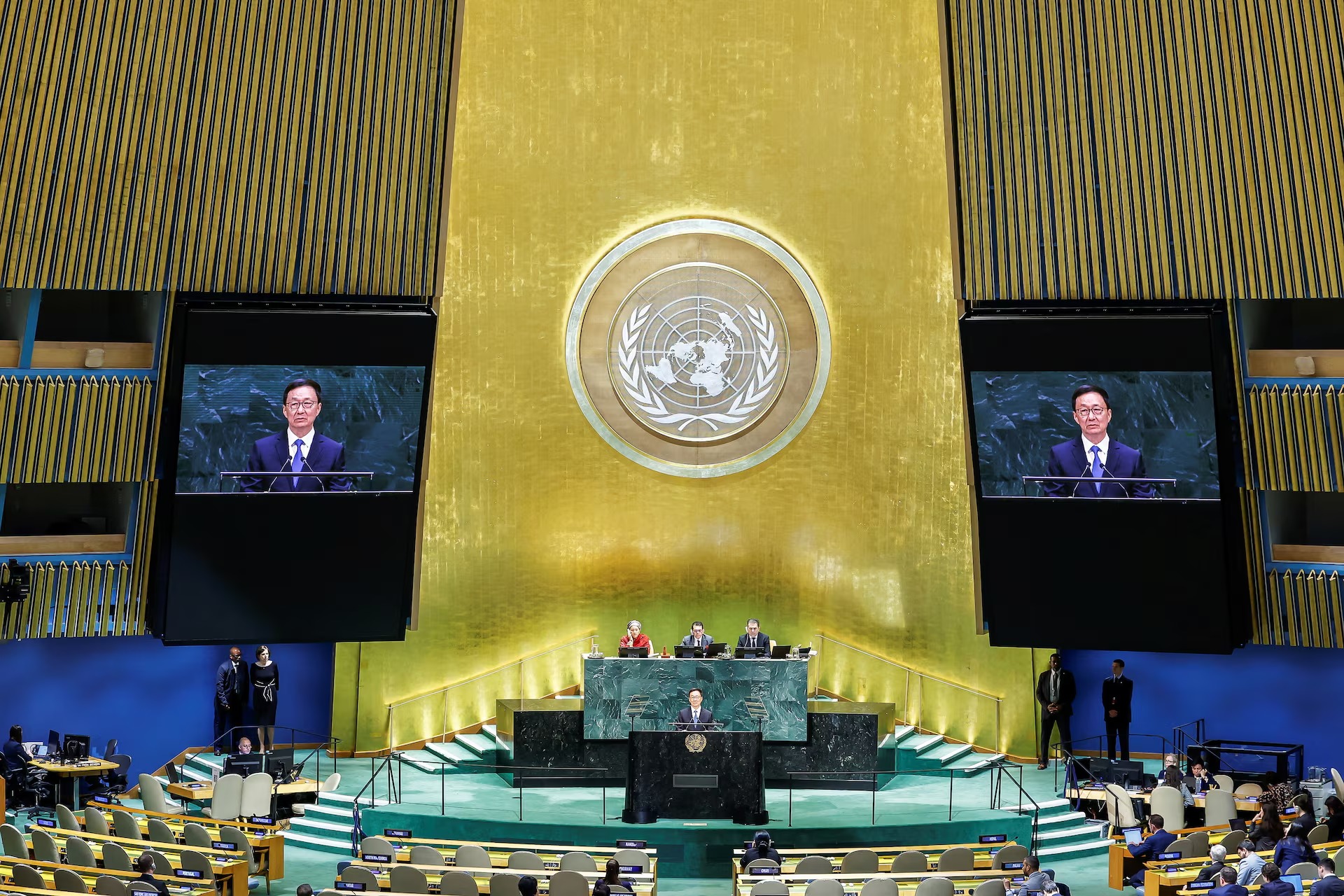
China used its address at the 81st United Nations General Assembly to defend national sovereignty, call for an end to sanctions on Cuba and present itself as a supporter of multilateral cooperation, highlighting differences with recent United States foreign policy positions.
Speaking at UN headquarters in New York on Saturday, Chinese Vice President Han Zheng urged countries to respect the sovereignty and security of nations in the Middle East and Gulf region. Although he did not directly name the United States, his remarks came amid continuing international debate over conflicts and security issues involving Iran and the wider region.
Han emphasized that major powers should play a responsible role in maintaining international peace and security. He said leading nations should respect international rules, support the rule of law and contribute to global stability.
According to Han, China believes that the sovereignty and security of countries in the Middle East, including Gulf states, should be fully respected. His comments reflected Beijing’s long-standing position that regional disputes should be resolved through dialogue and diplomacy rather than external pressure.
The speech came only days after Chinese President Xi Jinping visited Washington for high-level talks with U.S. President Donald Trump. The meeting was marked by warm public displays, including a state dinner and ceremonial events, signaling efforts by both sides to maintain communication despite ongoing disagreements on several international issues.
Even so, differences remain over Iran and regional security matters. Recent reports have highlighted concerns in Washington about China’s relationship with Tehran and allegations involving support that could help Iran manage international sanctions.
U.S. officials have also sought assurances that China would not provide assistance that could strengthen Iran’s military capabilities. Following the recent talks between Trump and Xi, American officials said they received commitments regarding Beijing’s approach toward Iran.
Another major focus of Han’s address was Cuba. China called for the removal of sanctions and restrictions that have affected the Caribbean nation’s economy and energy supplies.
Han urged what he described as the “relevant country” to stop threatening Cuba and to completely lift the blockade and sanctions imposed on the island. While he did not mention the United States by name, the remarks were widely understood to refer to Washington’s longstanding policies toward Havana.
China argued that economic restrictions have contributed to difficulties facing Cuba, including energy shortages and pressure on essential services. The issue has gained renewed attention after widespread power disruptions affected large parts of the country earlier this month.
Cuba’s electricity system has faced growing challenges due to aging infrastructure, fuel shortages and economic difficulties. Recent blackouts have left millions of people without reliable power and increased concerns about the country’s energy security.
Support for Cuba was also echoed later in the day by Russian Foreign Minister Sergey Lavrov. He called for an end to restrictions on trade with Cuba and urged the removal of the country from the U.S. list of state sponsors of terrorism.
Beyond regional issues, Han used his speech to present China as a reliable partner for developing nations. He emphasized the importance of equality among countries regardless of size, wealth or military power.
According to Han, international affairs should be handled through consultation and cooperation rather than unilateral action. He argued that all countries should have a voice in addressing global challenges and shaping international decisions.
The address reflected Beijing’s broader diplomatic message that supports multilateral institutions and greater involvement of developing countries in global governance. Chinese officials have increasingly promoted this position at international forums as the country expands its influence across Asia, Africa, Latin America and the Middle East.
The speech also highlighted ongoing geopolitical divisions at the United Nations. While major powers continue to cooperate on some issues, disagreements over sanctions, regional conflicts and international security remain central topics in global diplomacy.
As world leaders continue meetings at the General Assembly, China’s message underscored its efforts to portray itself as a defender of sovereignty, international cooperation and the interests of developing nations, while offering an alternative perspective on several key international disputes.
