

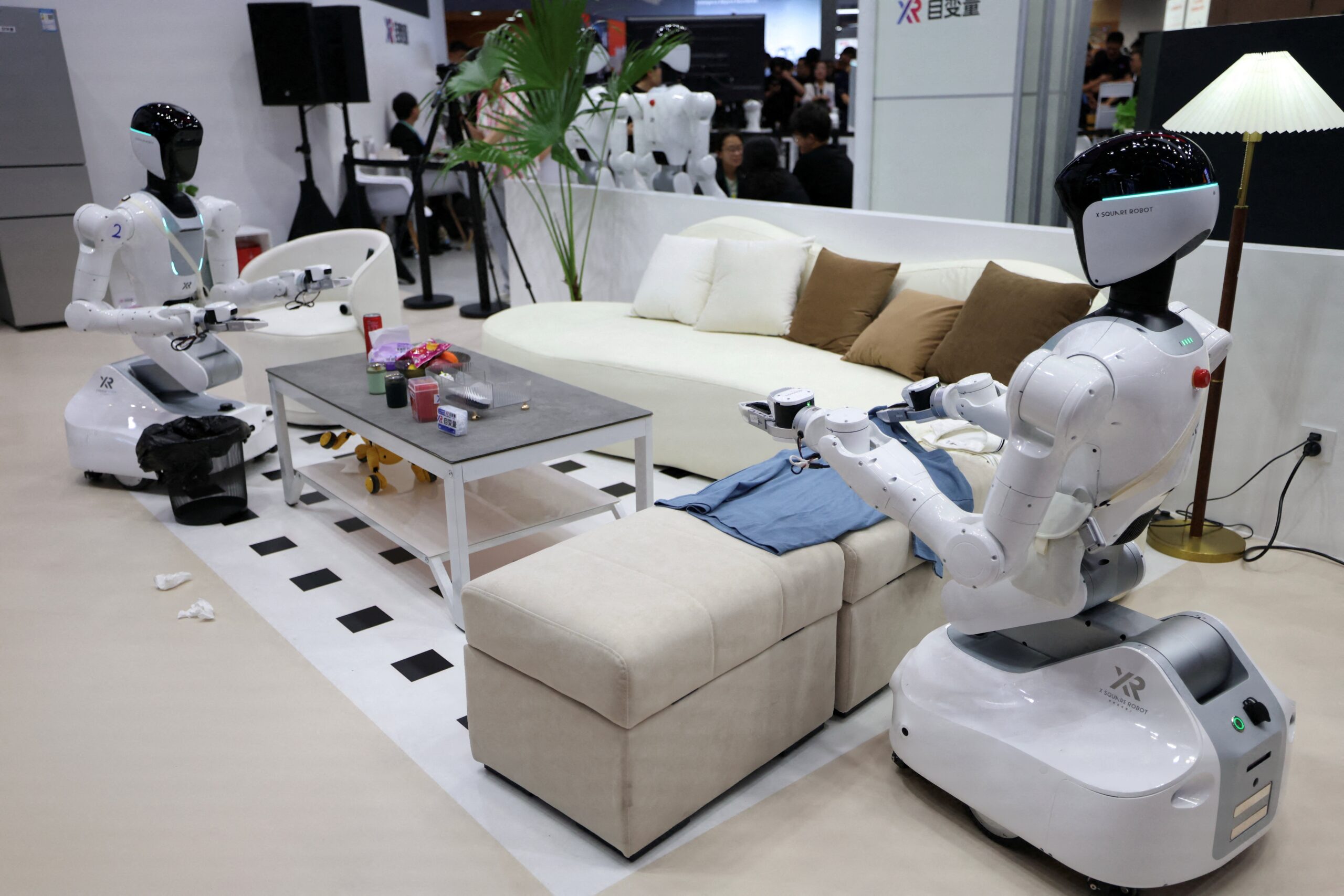
Chinese companies are shifting their focus from building advanced humanoid robots to developing the artificial intelligence that could make them useful at work. The move is driving a surge in investment in embodied AI, which helps robots understand the world and learn new tasks.
For years, Chinese robot makers have shown machines that can run, dance and perform backflips. But these skills do not always translate into useful work. Companies now want robots that can handle different jobs without needing new code for every task.
The change is attracting major funding. Chinese embodied AI firms raised 93.5 billion yuan, or about $13 billion, in the first half of 2026. The money came through 322 deals, five times the total recorded a year earlier, according to data firm ITjuzi.
Investment is now reaching software developers as well as companies that build robots. The aim is to create smarter machines that can work in factories, warehouses, shops and other settings.
As hardware prices fall, robot makers are looking for new ways to earn money. Dermot McGrath, founder of Shanghai-based technology consultancy ZenGen Labs, said companies believe the main source of future profit will be robot intelligence rather than the machines themselves.
This race is also adding a new front to the technology rivalry between China and the United States. US firms have an edge in some advanced AI systems and access to powerful computing chips. Chinese companies hope their manufacturing strength and close links with industrial customers will help them catch up.
The country that best combines AI with machines could gain a major advantage in factory work, logistics and other industries. Better robot intelligence could raise productivity and change the global market for automation.
Spirit AI co-founder Gao Yang said the intelligence behind a robot remains one of the weakest parts of the technology.
US startups such as Physical Intelligence, Skild AI and Generalist are working on AI models that can teach robots a wide range of skills. Generalist says its GEN-1.5 model completed about 60% of simple tasks after watching a demonstration lasting three to 12 seconds.
Chinese firm X Square has also published research showing that robots can learn handling skills from a single human video without retraining the model for each task.
Robotics consultant Georg Stieler said leading US labs set a high standard for how quickly robots can learn and reuse skills. However, he sees China’s strongest startups as serious competitors.
Chinese companies are working closely with manufacturers and industrial customers. This gives them chances to test their systems in real workplaces and improve them based on results.
X Square, Galaxea and Spirit AI have each reached valuations of around $3 billion, according to company disclosures. X Square co-founder Yang Qian said the goal is to move robots away from rigid code and towards decisions based on common sense.
Large manufacturers are also investing in AI. Hong Kong-listed UBTech advertised a chief scientist role focused on AI model development, with total compensation of up to 124 million yuan, including shares and benefits.
Unitree, one of the world’s largest humanoid robot makers by shipments, has about 30 researchers working on AI that can predict how objects behave, according to a person briefed by the company.
Training robots remains a major challenge. Unlike chatbots, which learn from large amounts of online text, robots need data showing how objects move and respond to touch. They must learn tasks such as gripping tools, moving boxes and handling flexible wires.
Chinese firms are collecting this data in several ways. Spirit AI has hired about 1,000 people to record everyday and industrial tasks, Gao said. ACE Robotics uses wearable sensors to record workers’ movements and grip forces in shops and hotels.
Ant Group’s robotics unit, Robbyant, said it trained a model using 160,000 hours of material. This included 50,000 hours of human-guided robot movements. The company also trained its software on 20 robot designs from 17 brands, with the aim of using one AI system across different machines.
DexForce uses computer-generated environments to train robots. Chief operating officer Nicole Yang said some industrial tasks can be prepared for use within six to eight hours. She also reported success rates above 99.9% in certain precision operations.
Yet virtual training has limits. Jerry Wang of Manycore Tech said simulated worlds cannot fully copy the complex physical interactions found in real life. X Square’s Yang also stressed that high-quality data matters more than collecting huge amounts of information.
Chinese developers face other barriers. US export controls limit access to advanced Nvidia chips, while concerns about high valuations and crowded markets have made public funding harder to secure.
JoyIn Technology’s Zhu Mingxuan said the shortage of advanced chips could become a serious problem as robot AI systems grow more powerful. Chinese firms are trying to reduce their computing needs through efficient models, synthetic data and simulations. Domestic chipmakers, including Huawei, are also developing alternatives, but it remains unclear how much these efforts can help.
Some companies are already testing robots in real workplaces. JoyIn described an experiment in which a robot struggled to put headphones in a cupboard beyond its reach. After watching videos of people solving the problem, it pushed a box towards the cupboard and tried to climb onto it.
Spirit AI said its robots connect flexible wires during battery-pack testing at a CATL plant, with insertion success above 99%. Robbyant said its robots also handle orders at two pharmacies in Shanghai, while staff check the medicines before they are sent out.
Unitree founder Wang Xingxing recently said the company had tested OpenAI’s GPT-6 on robots with encouraging results. He suggested that GPT-7, if released next year, could bring a major leap in robot abilities.
Wang said a true turning point would come when robots could complete 80% of tasks in 80% of unfamiliar settings after receiving spoken instructions.
However, a strong performance in a demonstration does not guarantee that a robot is ready for daily commercial use. Stieler warned that broad and reliable use could still take years, even if early breakthroughs arrive much sooner.
