

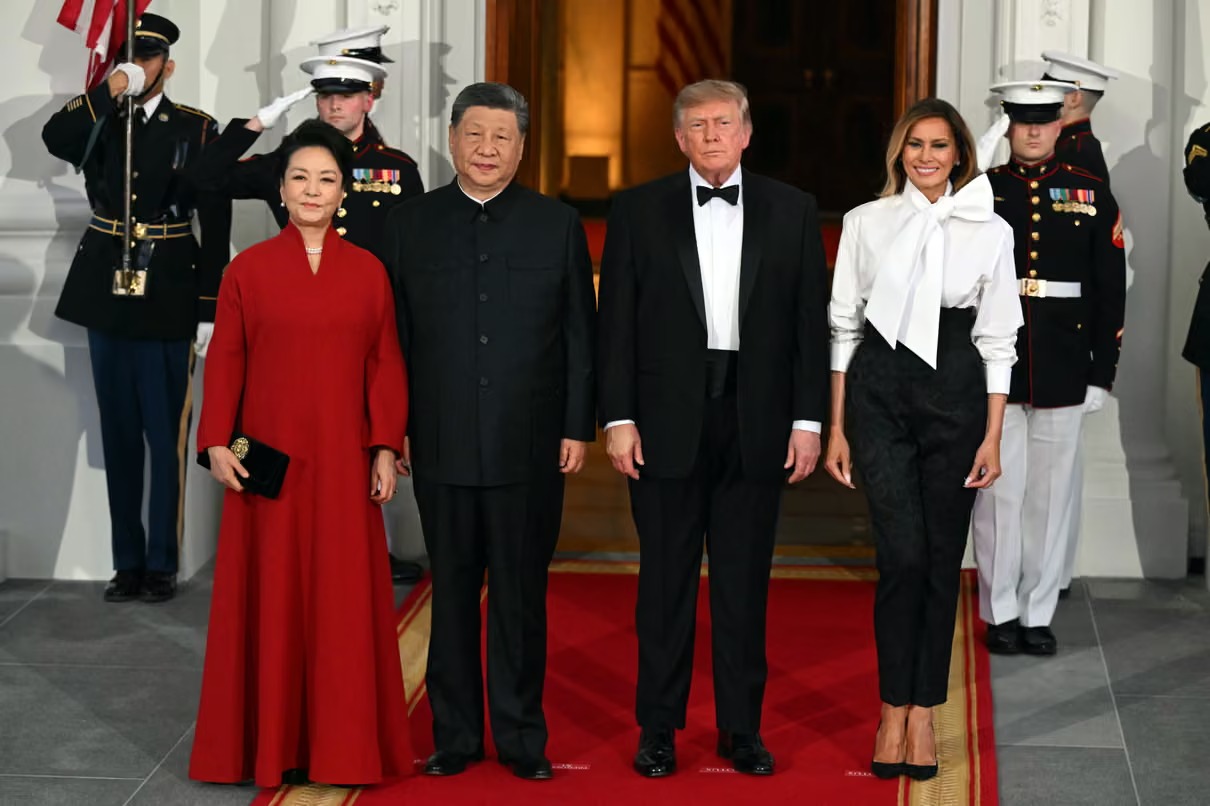
The latest meeting between U.S. President Donald Trump and Chinese President Xi Jinping produced grand ceremonies and positive public remarks, but delivered few concrete outcomes on the major issues dividing the world’s two largest economies.
The three-day state visit in Washington was filled with high-profile events, official receptions and symbolic displays of friendship. Trump welcomed Xi with special honors and hosted a series of activities designed to highlight the importance of the relationship between the United States and China.
Despite the attention surrounding the summit, analysts noted that the gathering resulted in limited progress on some of the most difficult issues facing the two countries.
The meeting came months after Trump and Xi held talks in Beijing. Expectations for the Washington summit were modest, with both sides hoping to maintain stable relations rather than secure major breakthroughs.
Trade remained one of the most important topics. The United States and China have spent years managing tensions over tariffs, market access and trade imbalances. Those disagreements have affected businesses, consumers and supply chains around the world.
Although both governments recently maintained a temporary trade truce, uncertainty remains over the long-term direction of economic relations. The current agreement is scheduled to expire later this year.
One of the few notable outcomes from the summit was an extension of the trade truce. However, the extension was limited in scope and fell short of broader expectations that had circulated before the meeting.
Experts said the short extension reflects the continued differences between Washington and Beijing. While both sides appear interested in avoiding a major escalation, significant disagreements remain unresolved.
Trade has become especially important because the United States and China account for a large share of global economic activity. Any changes in their relationship can affect markets, investment and economic growth around the world.
Another important issue is access to critical minerals and technology. China remains a major supplier of rare earth materials that are widely used in manufacturing, electronics and defense industries. These resources have become a key part of the broader economic competition between the two countries.
Beyond trade, the summit produced little visible progress on several major international issues. Topics such as artificial intelligence, Taiwan, the war in Ukraine and tensions in the Middle East remained areas of disagreement.
Taiwan continues to be one of the most sensitive subjects in U.S.-China relations. Beijing considers the island part of China, while the United States maintains unofficial ties with Taiwan and continues supporting its ability to defend itself.
Chinese officials reportedly raised concerns about American support for Taiwan during the discussions. However, no major policy changes were announced following the summit.
Artificial intelligence was another topic closely watched by observers. As competition in advanced technology grows, both countries are seeking leadership in the rapidly developing field.
Despite increasing global debate over AI regulation and safety, the summit did not produce any major joint initiatives or agreements on the issue.
The absence of significant announcements led some analysts to conclude that symbolism played a larger role than policy during the visit. The summit featured extensive public events, formal ceremonies and carefully managed appearances by both leaders.
For China, the visit was widely viewed as a diplomatic success because it provided Xi with high-profile international exposure without requiring major concessions on key issues.
Images of Trump and Xi meeting as equals on the world stage received extensive attention and reinforced China’s image as a leading global power.
Observers noted that Beijing’s primary goal may have been stability rather than dramatic agreements. Maintaining predictable relations with Washington remains important for China’s economy and international standing.
For the United States, the summit demonstrated continued engagement with a key global rival while keeping communication channels open on major issues.
As the visit concluded, many of the biggest challenges between the two countries remained unresolved. Trade disputes, technology competition, Taiwan and international security issues are expected to continue shaping the relationship in the months ahead.
While the Trump Xi summit generated headlines and diplomatic pageantry, its most important outcome may have been preserving dialogue between two nations whose relationship remains critical to global politics and the world economy.
