

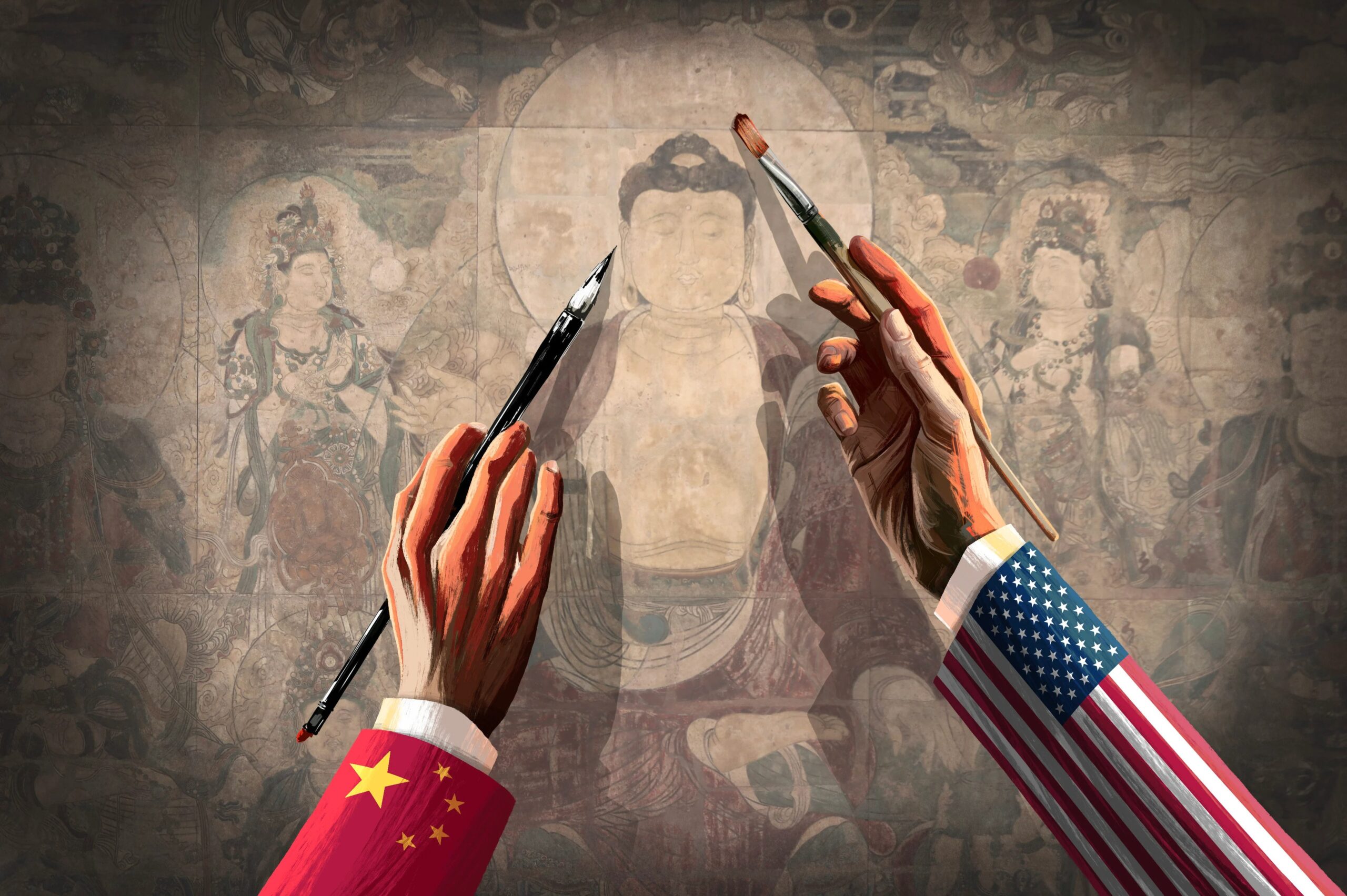
A large Buddhist mural at the Metropolitan Museum of Art in New York has become the focus of a rare cultural project between the United States and China. The artwork draws visitors into the world of ancient Chinese religious art and shows how shared history can build links between countries.
The mural stands in Gallery 206, which displays Chinese Buddhist art. It covers a wall more than 15 metres wide and 7.5 metres tall. The huge scene fills the gallery with images of Buddhist figures and deities.
Known as the Medicine Buddha mural, the work dates to the 14th century. It was created during China’s Yuan dynasty, which ruled from 1279 to 1368. The mural originally came from Guangsheng Temple in Shanxi province in central China.
Its size and detail make it one of the striking works in the museum’s Chinese galleries. Visitors entering the room see a large Buddhist gathering painted across the wall. The calm faces, rich colours and many figures create a strong sense of scale.
The mural uses mineral pigments, which give its colours a deep and lasting quality. Its central religious figure is the Medicine Buddha, a figure linked to healing and relief from suffering in Buddhist belief. Other deities and attendants surround the main figure, forming a broad and carefully arranged scene.
The work also offers a view of the skill of artists who created religious paintings centuries ago. Such murals were made for temples and helped shape the spaces where people gathered to pray and study Buddhist teachings. Their large size allowed the images to become part of the building itself.
Moving a historic mural from its original home can be difficult. Age, fragile surfaces and changes in the building can all put ancient paintings at risk. Museums must also find ways to help visitors understand how such works once looked in their original settings.
The Medicine Buddha mural’s presence in New York has created an opportunity to explore these questions. A life-size replica has helped spark a rare project involving partners in the United States and China. The effort shows how modern methods can support the study and sharing of historic art.
A replica can offer more than a simple copy of a painting. When made at full scale, it can help people understand the work’s original size and visual effect. It can also provide researchers and visitors with a way to study details that might be hard to see in photographs or smaller reproductions.
The project also highlights the value of cooperation between museums and cultural experts. Historic art often carries meaning for more than one country. Its preservation can depend on the exchange of knowledge, careful research and respect for its place of origin.
For Chinese Buddhist art, this kind of work can help connect present-day audiences with traditions that developed over many centuries. The mural reflects religious beliefs, artistic methods and temple culture during the Yuan period. It also shows how artists used colour and scale to create powerful images for worship.
For visitors to the Metropolitan Museum of Art, the mural offers a moment away from the busy streets of Manhattan. Its broad wall of figures invites people to pause and look closely at a world shaped by faith and artistic skill.
The replica project gives that experience a wider reach. By bringing people and expertise together across borders, it offers a way to study and share an important piece of cultural heritage.
The Medicine Buddha mural remains a reminder that art can travel far beyond the place where it was first created. Centuries after its creation in China, it continues to draw attention in New York and now helps create new links between cultural institutions in both countries.
