

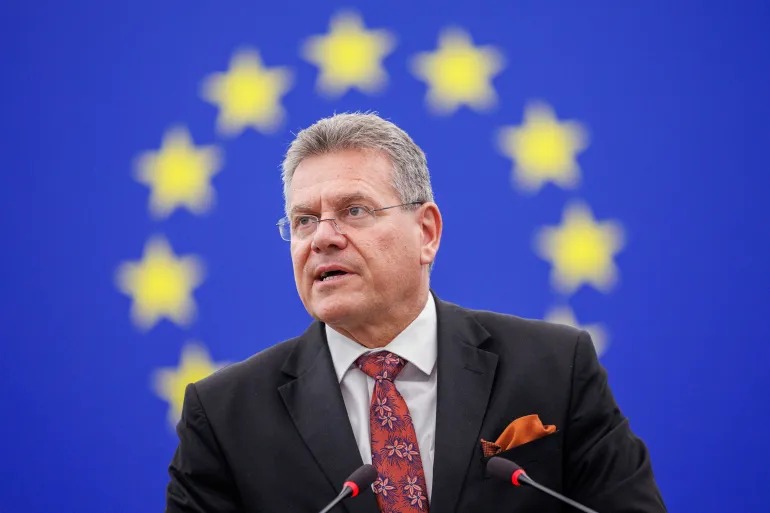
European Trade Commissioner Maros Sefcovic has arrived in Beijing for high-level discussions aimed at addressing growing trade tensions between the European Union and China.
The talks come after months of negotiations over a widening trade imbalance, market access concerns and restrictions affecting critical supply chains. European officials are seeking concrete progress ahead of a meeting of EU leaders scheduled for next week in Brussels.
Sefcovic is expected to meet Chinese Commerce Minister Wang Wentao during two days of discussions focused on trade relations between the world’s second-largest economy and one of its most important trading partners.
At the center of the negotiations is the European Union’s growing trade deficit with China, which European officials say has reached an unsustainable level.
EU leaders have increasingly expressed concern that trade relations are becoming unbalanced, with Chinese exports continuing to grow rapidly while European companies face barriers in certain sectors of the Chinese market.
The issue has become one of the most important economic challenges facing the relationship between Brussels and Beijing.
Another major topic is China’s export controls on rare earth materials and other critical minerals.
These resources are essential for industries including electric vehicles, renewable energy systems, advanced manufacturing and defense technologies. European policymakers have argued that restrictions on access to such materials create risks for industrial supply chains across the continent.
The negotiations are taking place amid rising competition between Chinese and European manufacturers.
Chinese companies have expanded their presence in global automotive markets and are increasingly challenging established European brands. The rapid growth of Chinese vehicle exports has become a major concern for policymakers and industry leaders across Europe.
Recent reports indicate that discussions are continuing over potential measures related to vehicle imports.
According to diplomatic sources, European officials are exploring options designed to address concerns about rising imports while maintaining dialogue with Beijing. China has opposed proposals that it views as restrictive and has called for open trade and fair competition.
The talks also come at a politically significant moment within the European Union.
On Wednesday, a majority of EU lawmakers backed a resolution calling for a stronger and more assertive trade policy toward China. While the resolution is not legally binding, it reflects growing support within Europe for tougher action to address trade concerns.
Chinese officials responded by warning that any restrictions targeting Chinese companies or products would receive a firm response.
Beijing has repeatedly argued that accusations involving industrial overcapacity and trade imbalances are being used as tools to limit China’s economic growth and competitiveness.
At the same time, Germany and France have increased pressure for new trade defense measures within the European Union.
French President Emmanuel Macron and German Chancellor Friedrich Merz recently called for the development of a rapid-response mechanism that could allow the EU to react quickly to economic actions viewed as harmful to European interests.
The proposal would not target any specific country but would provide the European Commission with broader authority to respond to trade disputes in a matter of days rather than months.
Supporters argue that the EU needs stronger instruments to defend its economic interests in an increasingly competitive global environment.
Chinese officials criticized the proposal and urged European governments to avoid protectionist policies.
Beijing said major economies should continue supporting free trade, international cooperation and open markets rather than introducing new restrictions.
The debate reflects broader disagreements over how global trade should be managed as economic competition intensifies among major powers.
Trade relations between the EU and China have been under review since June, when both sides began a series of discussions aimed at reducing tensions and finding common ground on economic issues.
Sefcovic has repeatedly stated that Europe wants meaningful progress and practical commitments before EU leaders gather next week.
European Commission President Ursula von der Leyen has also warned that the trade relationship has reached what she described as a critical point.
She recently told lawmakers that Europe is prepared to use all available tools to restore balance and protect the interests of European industries.
The outcome of the Beijing meetings could therefore play a major role in shaping future EU-China relations.
With economic concerns rising on both sides, officials are under pressure to deliver progress that can reduce tensions while preserving one of the world’s most important trading relationships.
As discussions continue, businesses and policymakers will be watching closely for signs of compromise that could help stabilize trade ties between Europe and China in the months ahead.
