

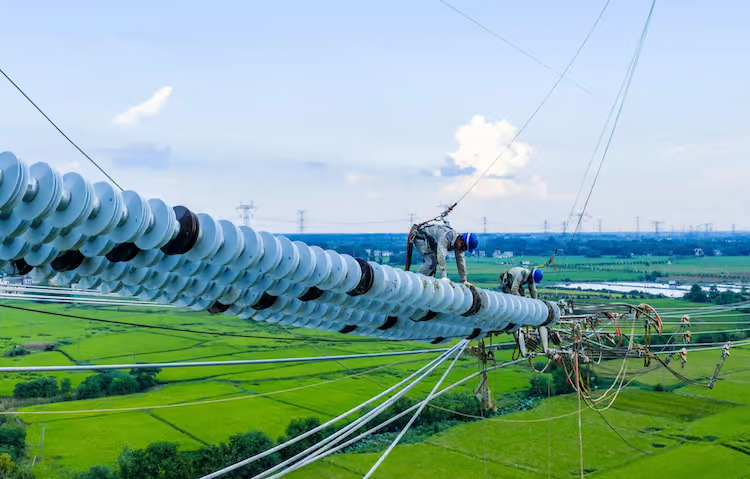
China is launching a major effort to improve its electricity network as the country seeks to make better use of the vast renewable energy capacity it continues to build each year.
The initiative forms part of China’s latest Five-Year Plan and focuses on reducing the growing amount of clean electricity that cannot reach consumers because of transmission and grid limitations.
China remains the world’s largest builder of renewable energy projects, including solar, wind and other clean power technologies. However, renewable generation has expanded faster than parts of the national grid can absorb and distribute.
As a result, a significant amount of available electricity is being wasted.
Industry estimates indicate that China curtailed about 360 terawatt-hours of intermittent renewable power during 2025. That figure represented a sharp increase compared with the previous year and highlighted the growing challenge facing the country’s energy system.
Curtailment occurs when electricity generated by renewable facilities cannot be delivered to consumers because transmission networks lack sufficient capacity or flexibility.
The issue has drawn increased attention from policymakers, grid operators and energy researchers.
One of the most important elements of the new strategy is a requirement that all newly built ultra-high-voltage direct current transmission lines carry at least 50 percent renewable energy.
The target represents a major shift in China’s approach to long-distance electricity transmission.
Researchers note that renewable energy currently accounts for a much smaller share of electricity flowing through existing ultra-high-voltage transmission corridors.
Data from recent years show that wind and solar power have represented only about one-fifth of the electricity transported through many of China’s operational ultra-high-voltage direct current lines.
Under the new policy, future projects will be expected to carry a significantly larger share of clean energy.
The government has also introduced region-specific integration targets designed to reduce renewable energy waste.
Different provinces and regions will face different requirements depending on their current curtailment rates. Areas with higher levels of wasted renewable power are expected to take stronger action to improve grid performance and increase utilization.
China’s focus on large-scale electricity transmission is not new.
For years, the country has invested heavily in building some of the world’s most advanced power networks. These systems are designed to move electricity across thousands of kilometers from resource-rich regions in the west and north to densely populated industrial centers in the east.
The country now operates the world’s largest network of ultra-high-voltage transmission infrastructure.
Many of these lines transport electricity over extraordinary distances. Some connect remote renewable energy hubs with major manufacturing and urban regions located more than 3,000 kilometers away.
One of the most notable examples is the Changji-Guquan transmission line, which links northwestern China with eastern industrial centers. The project is recognized as one of the longest and highest-voltage power transmission systems in operation anywhere in the world.
China continues to invest heavily in grid modernization.
Officials have outlined plans to expand nationwide transmission capacity through additional ultra-high-voltage projects over the coming years. The goal is to create a more connected national power system capable of handling growing volumes of renewable generation.
New technologies are also expected to play an important role.
Engineers are increasingly deploying advanced voltage source converter high-voltage direct current systems. These technologies offer greater flexibility than traditional transmission lines and may allow electricity to be integrated from multiple renewable energy sources along a transmission route.
Such innovations could improve the efficiency of long-distance power delivery and reduce the amount of renewable electricity that goes unused.
China has already become one of the world’s most electrified economies. Rapid growth in electric vehicles, high-speed rail systems and electric-powered infrastructure has significantly increased demand for clean electricity.
Yet energy experts argue that expanding renewable generation alone is not enough.
Greater benefits will depend on improving the ability of the grid to move power from where it is produced to where it is needed.
The new Five-Year Plan reflects that reality by placing increased emphasis on transmission, integration and grid efficiency.
If successful, the strategy could unlock much greater use of renewable energy already being produced and strengthen China’s position as a global leader in clean energy development.
As investment continues, the country’s ability to reduce renewable energy waste may become one of the most important measures of its future energy transition.
