

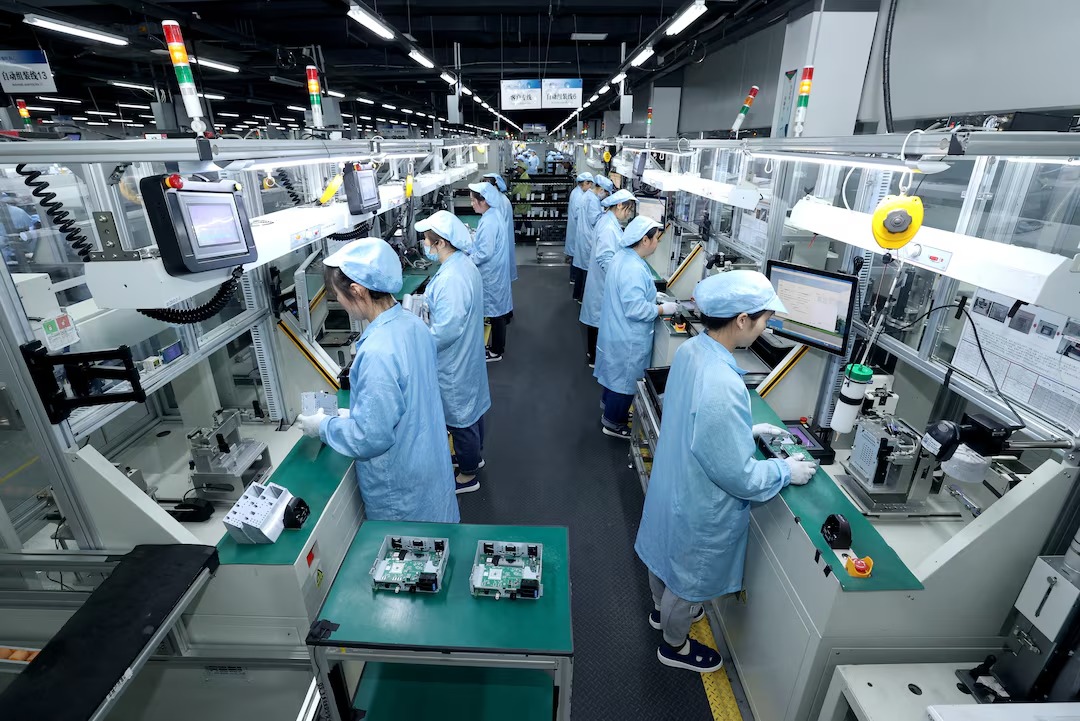
China’s producer prices rose at their fastest pace in more than four years in September. Higher oil and commodity costs pushed up prices for goods leaving factories. However, weak domestic demand continued to limit wider inflation.
Official data released on Wednesday showed that factory prices rose 5% from a year earlier. This was faster than the 3.8% increase recorded in August. It also beat economists’ forecast of 4.5%.
The latest rise marked the strongest increase in producer prices since June 2022. It suggests that Chinese manufacturers are facing higher costs. Yet many households remain cautious about spending, leaving consumer price growth relatively low.
The gap between factory prices and consumer inflation highlights an uneven recovery in China. Exports have supported economic activity, but household spending and private-sector confidence remain weak. This has raised concerns about the strength of demand across the wider economy.
Higher oil and commodity prices have played a major role in the rise in factory costs. Transport disruptions, poor weather and geopolitical tensions have affected supplies. The conflict in the Middle East has also added pressure to commodity markets.
Nguyen Hoang Nam, a China economist at Capital Economics, said supply problems linked to the Middle East conflict had driven much of the increase. Prices rose sharply in fuel processing, chemicals and non-ferrous metals. He expects producer prices to fall back next year.
Manufacturers may find it difficult to pass all these higher costs on to customers. Weak demand limits their ability to raise selling prices. As a result, companies could face pressure on their profit margins if input costs remain high.
Consumer inflation also increased in September, but the rise was modest. China’s consumer price index climbed 0.9% from a year earlier. This followed a 0.8% increase in August. The result was below the 1% rise expected by economists.
Fuel prices were a key factor behind the increase. Gasoline prices jumped 16.6% compared with the same month last year. The statistics agency said gasoline added about 0.47 percentage points to overall consumer inflation.
Despite higher fuel costs, underlying price pressure remained limited. Core inflation, which excludes food and energy, rose 1% from a year earlier. This was unchanged from August and suggests that broader consumer demand has yet to strengthen much.
Monthly figures also showed a modest increase in consumer prices. The consumer price index rose 0.2% from August. Economists had expected a 0.3% gain, while prices had increased by 0.4% in the previous month.
Zhou Hao, chief economist at Guotai Junan International, said the key issue is whether stronger industrial activity can support jobs, incomes and consumer confidence. If factories become more active and workers see better income growth, households may feel more willing to spend.
He said a stronger link between industrial growth and household demand could help narrow the gap between producer and consumer prices. Such a change could support a more balanced and lasting recovery in 2027.
China’s financial markets showed little reaction to the latest data. The blue-chip CSI300 index fell 0.1%, while the Shanghai Composite Index rose 0.1%.
Beijing has introduced several measures to support growth. The government approved an additional 550 billion yuan, worth about $82.15 billion, in unused local government bond quota. The funds can support infrastructure and other spending.
The move adds to earlier steps, including mortgage subsidies, aimed at supporting economic activity. However, the latest inflation figures suggest that policy support has yet to produce a strong rise in household demand.
China now faces a difficult balance. Higher commodity costs are pushing up factory prices, while consumers remain careful with their money. A lasting recovery may depend on whether stronger industrial activity can lead to better jobs, higher incomes and more confident spending.
