

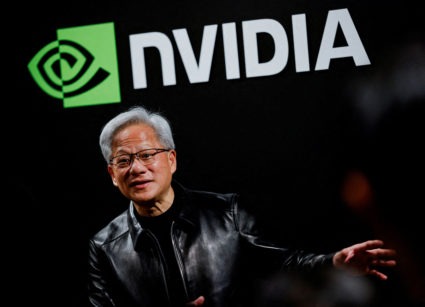
The reported affair between Nvidia chief executive Jensen Huang and a woman accused of having links to Chinese intelligence has raised questions about possible national security risks for the United States. A former US intelligence official says the alleged operation may have aimed to gain personal access to Huang or influence his role in America’s technology policy.
Christopher Johnson, who spent 20 years in the US intelligence community focusing on China, discussed the case in an interview with PBS NewsHour. He now leads the consulting firm China Strategies Group.
Johnson said China’s national strategy often involves using different methods to secure important technology and other capabilities. These methods may include business relationships, influence efforts and the theft of sensitive information.
He said there could be two possible reasons for an alleged intelligence operation involving Huang. One possibility was to place someone close to the Nvidia chief to gain access to his personal devices, including his phone and computer.
Such access could potentially expose private communications, business information or other sensitive material. However, Johnson said the information reported so far appeared to point towards a wider influence effort.
He suggested that the main goal may have been to encourage Huang to use his access to US President Donald Trump. The aim, according to Johnson’s assessment, may not have been to remove existing restrictions on chip exports to China but to prevent Washington from introducing further limits on Nvidia sales.
The issue is important because advanced artificial intelligence chips remain a central part of the technology competition between the United States and China. Washington has imposed export controls to limit China’s access to some powerful processors.
Nvidia is a major supplier of advanced chips used in artificial intelligence systems and data centres. Its products are important to the global AI industry, making the company a key part of the wider US effort to maintain its position in advanced computing.
Johnson said the reported influence effort could show that Beijing remains concerned about US control over advanced chip exports. Although China has publicly highlighted its progress in artificial intelligence, restrictions on access to advanced processors remain a major challenge for its technology sector.
During the interview, PBS NewsHour anchor Amna Nawaz also asked how common it was for Chinese intelligence agencies to use personal relationships to approach important targets.
Johnson said such methods were less common in China’s known intelligence history than in the operations of Russian intelligence services. However, he stressed that Chinese agencies were not unfamiliar with this approach.
He described a method known as an access agent operation. In such cases, intelligence services may recruit or use someone who already has a close relationship with a target. That person can then help the service gain influence or access without approaching the main target directly.
The case has also drawn attention from US lawmakers, who want to understand whether any sensitive information was exposed. Johnson said investigators and lawmakers would need to examine how the matter was handled inside the Trump administration.
He noted that a typical counterintelligence investigation could involve the Justice Department’s National Security Division, the FBI and the CIA’s counterintelligence unit.
However, some reports have suggested that Secretary of State Marco Rubio played a central role in handling the issue. Johnson described this as unusual and said lawmakers should ask how information about the alleged operation was collected, reviewed and shared.
Another key question is whether Huang knew about the woman’s alleged links to Chinese intelligence. Johnson said he believed Huang probably had no such awareness, although he stressed that investigators would need to establish the facts.
Lawmakers may also examine whether Nvidia chips were diverted to Chinese companies through businesses linked to the woman or through other companies operating in Southeast Asia. Such transfers could raise concerns about efforts to bypass US export restrictions.
Reports have also suggested that senior Trump administration officials received information about the alleged affair around a year before it became public. The New York Times reported that officials did not take action at the time.
Johnson said this did not necessarily mean the administration had concluded that there was no national security risk. He suggested that the wider competition with China may have influenced the government’s response.
He pointed to Trump’s public comments about artificial intelligence and the need for the United States to remain ahead of China. In Johnson’s view, the administration may have been concerned that action against Huang could affect a company that plays a major role in the US technology sector.
Trump has since said the FBI is investigating the matter. He has also expressed confidence in Huang after speaking with him. The investigation will need to establish whether the reported activity involved an intelligence operation and whether any sensitive information was obtained.
Huang’s relationship with Trump has added another dimension to the case. The Nvidia chief travelled with the president on Air Force One to China in May, joining several technology executives on the trip.
Trump may meet Chinese President Xi Jinping again later this month during the APEC summit. Reports have said the president wants Huang to join him on that visit as well.
The case now places several issues under scrutiny, including corporate security, foreign intelligence activity and US export controls. Any confirmed evidence of access to sensitive information could have wider consequences for Nvidia and the technology relationship between Washington and Beijing.
