

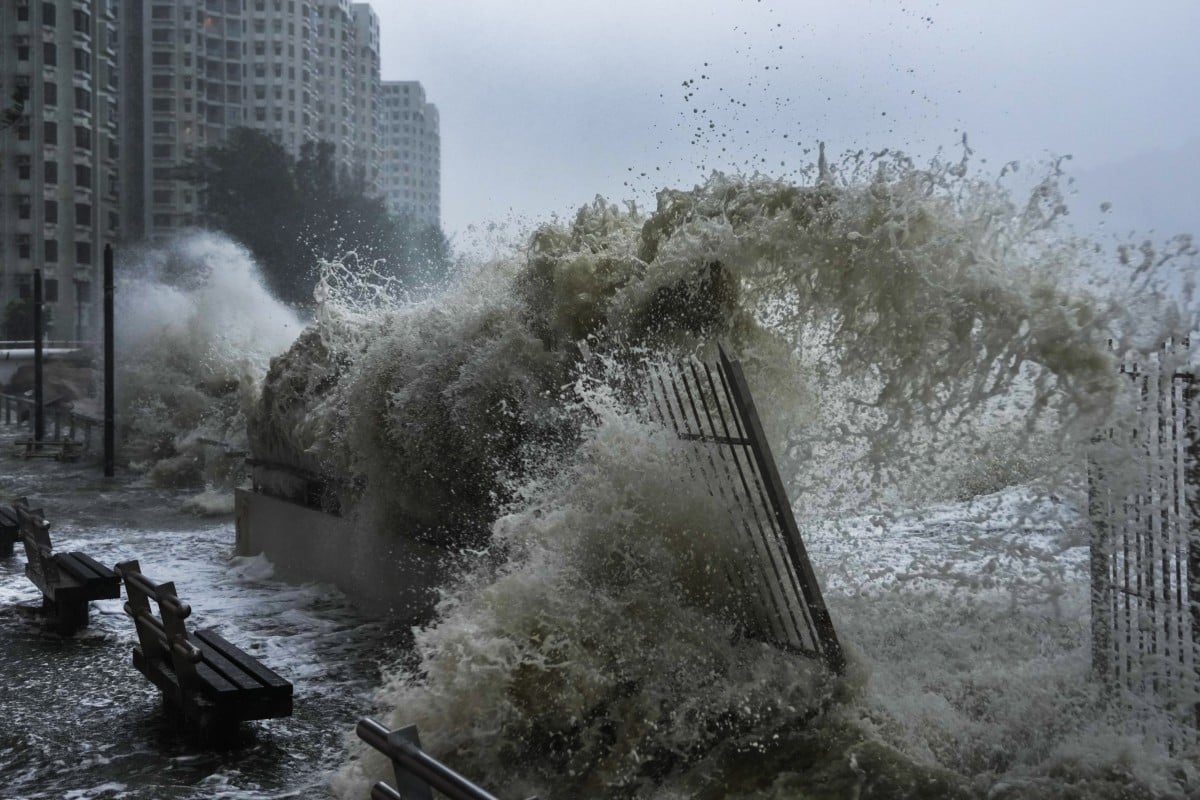
Hong Kong is likely to see fewer typhoons in the future, but the storms that do occur will be stronger and more destructive, experts warn.
Leung Wing-mo, former assistant director of the Observatory and spokesman for the Hong Kong Meteorological Society, said property owners should use wooden panels and stronger breakwaters, as tape cannot withstand powerful waves.
“If we follow global scientific consensus, the total number of tropical cyclones will not rise due to climate change. In fact, it may decrease slightly,” Leung said.
Currently, the Western Pacific and South China Sea see about 30 tropical cyclones each year. In the future, this number could drop to 26, 27, or 28.
Despite fewer storms, the proportion of strong typhoons is expected to increase. “The ratio of super typhoons will be higher. Naturally, this means more destruction,” Leung said.
He added that storms would last longer at their peak strength. “If the period of strongest winds extends, the storm’s destructive power rises. Heavy rainfall will also increase,” he said.
Leung emphasized that future typhoons will follow a pattern: either there will be no storm or, if one occurs, it will be more powerful and cause greater damage.
This year, Typhoon Matmo became the 12th storm to trigger a typhoon warning in Hong Kong, the highest number since 1946. It followed Super Typhoon Ragasa, which forced the city to halt operations for two days, disrupted over 1,000 flights, damaged restaurants, injured more than 100 people, and toppled over 1,200 trees. Ragasa caused billions in losses.
Restaurants along Tseung Kwan O’s coast suffered heavy damage, with glass doors smashed and furniture swept onto the streets. Owners estimated repairs would cost millions of Hong Kong dollars, straining already struggling businesses.
Leung noted that restaurants protected with wooden planks avoided major damage, while those relying only on tape faced severe losses. “Property owners can take action by using wooden panels. The government should also strengthen breakwaters,” he said.
Although Tseung Kwan O has existing breakwaters, they are still insufficient. The Secretary for Development has confirmed that more will be built to protect the coastline.
Experts stress that preparation is key. Stronger storms in the future could bring longer-lasting winds and heavier rainfall, increasing the potential for property damage and flooding. Wooden boards, reinforced barriers, and government investment in coastal protection are critical measures.
Leung’s warnings align with international scientific studies on climate change and tropical cyclones. While fewer typhoons are expected, the risk from extreme events is rising, making early preparation vital for Hong Kong residents and businesses.
With climate change influencing storm patterns, the city faces a future where typhoon warnings may be less frequent, but each event could be far more dangerous. Wooden panels and upgraded breakwaters are simple, yet effective, solutions to reduce damage when these super typhoons strike.
