

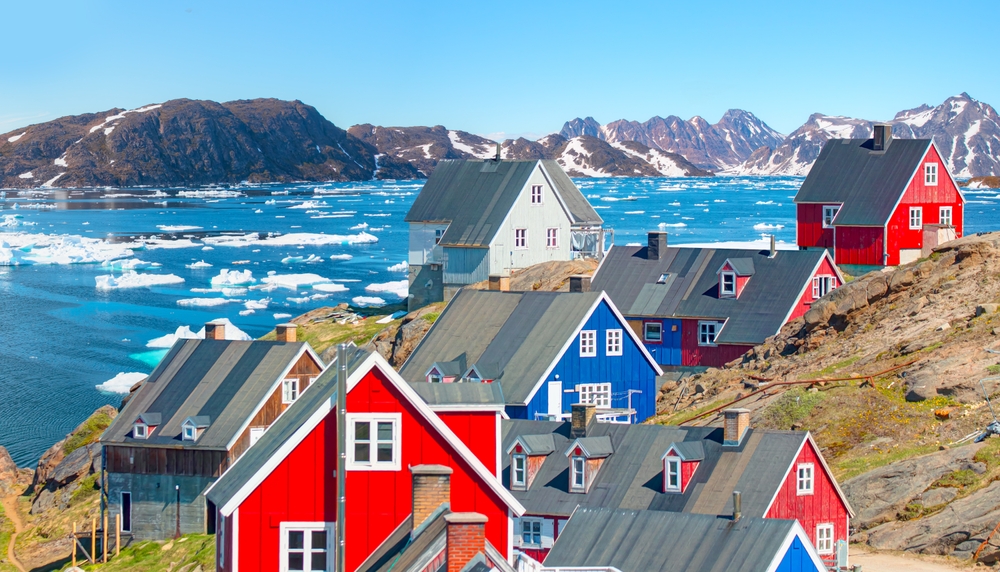
Greenland’s strategic location and vast natural resources have thrust the Arctic island into the center of a growing geopolitical dispute, after the White House said the use of the US military remains an option in President Donald Trump’s renewed push to bring the territory under American control.
Greenland, a self-governing territory within the Kingdom of Denmark, sits off Canada’s northeastern coast, with more than two-thirds of its land inside the Arctic Circle. Its position has made it vital to North American defence since World War II.
White House Signals Hard-Line Stance
White House press secretary Karoline Leavitt said late Tuesday that Trump views acquiring Greenland as a national security priority, particularly as competition intensifies in the Arctic.
“The president and his team are discussing a range of options to pursue this important foreign policy goal,” Leavitt said, adding that “utilising the US military is always an option at the commander in chief’s disposal.”
Trump first floated the idea of buying Greenland during his first term. The proposal gained new momentum after a recent US military operation that led to the seizure of Venezuelan President Nicolás Maduro, with Trump once again citing strategic concerns tied to China and Russia’s growing Arctic presence.
Leavitt’s remarks appeared to contradict comments from Trump’s special envoy to Greenland, Louisiana Governor Jeff Landry, and White House deputy chief of staff Stephen Miller, both of whom suggested military action would not be necessary. Republican House Speaker Mike Johnson also rejected the idea, saying he did not believe military action would be appropriate.
Allies Push Back and Defend Greenland’s Sovereignty
The White House statement triggered swift international reaction. Leaders from France, Germany, Italy, Poland, Spain and the United Kingdom joined Danish Prime Minister Mette Frederiksen in reaffirming that Greenland “belongs to its people.”
The joint statement emphasized that only Denmark and Greenland have the right to decide the island’s future. Canada also voiced strong support, with Prime Minister Mark Carney announcing that Governor General Mary Simon and Foreign Minister Anita Anand will visit Greenland next month.
“The future of Greenland and Denmark are decided solely by the people of Denmark,” Carney said while standing alongside Frederiksen in Paris.
Frederiksen and Greenland’s Prime Minister Jens-Frederik Nielsen have firmly rejected Trump’s renewed calls, warning that a US takeover would undermine NATO unity.
Despite the pushback, Stephen Miller insisted this week that Greenland should fall under US control, arguing it is essential to America’s security architecture. He questioned Denmark’s claim to the territory but said there was no need to frame the issue as a potential military confrontation.
Why Greenland Matters Strategically
Greenland’s importance extends far beyond diplomacy. The island hosts the US-operated Pituffik Space Base in the northwest, built under a 1951 defence agreement with Denmark. The base plays a key role in missile warning, missile defence and space surveillance for the US and NATO.
Greenland also sits along the GIUK Gap, a critical maritime corridor monitored by NATO to track Russian naval movements between Greenland, Iceland and the United Kingdom.
In addition to its military value, Greenland holds significant economic appeal. The island has large reserves of rare earth minerals essential for electronics, batteries and renewable energy technologies. The US Geological Survey has also identified potential offshore oil and natural gas deposits.
While Greenland gained expanded self-rule in 2009, including the legal right to pursue independence, most Greenlanders have shown little interest in becoming part of the United States. For now, the island’s future remains firmly in the hands of its people, even as global powers continue to eye its strategic potential.
