

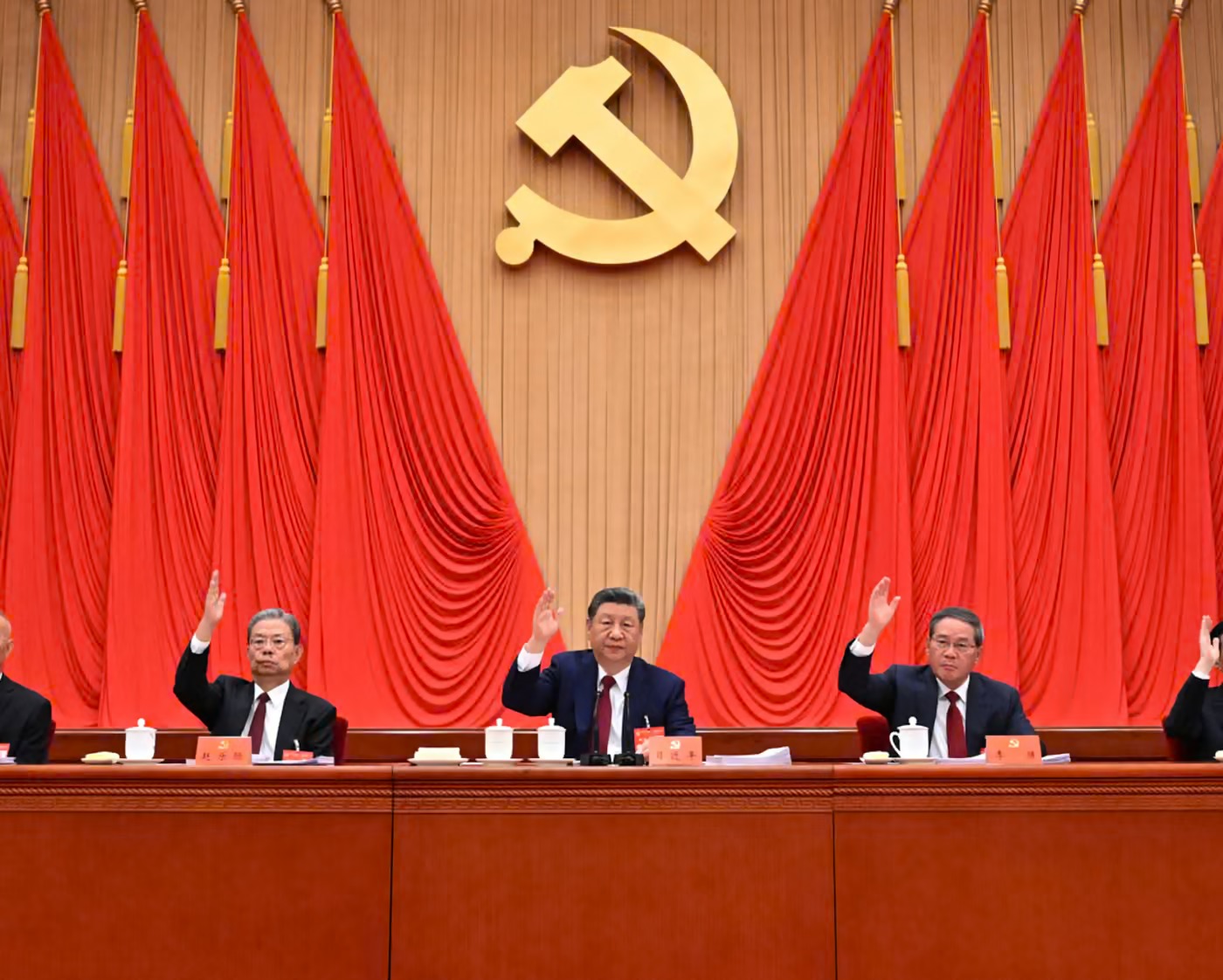
China has expelled a record 33 officials from the Chinese Communist Party (CCP) as President Xi Jinping continues his campaign against corruption and disloyalty. The decision came during a major meeting of senior party leaders in Beijing, where an unusually large number of empty seats showed the scale of the recent purges.
The meeting, known as the fifth plenum, brought together members of the party’s Central Committee. This body plays a key role in shaping China’s political direction and major national policies.
Only 279 full and alternate members attended the gathering. The Central Committee originally had 376 members when it was formed in 2022. This means more than a quarter of the original group was absent.
The number of empty seats was the highest seen at a plenum in modern Chinese history. While some absences remain unexplained, several officials have been removed from the party as part of Xi’s expanding crackdown.
The latest expulsions highlight the growing reach of the campaign. They also raise questions about the balance between efforts to fight corruption and the leadership’s drive to maintain strict political control.
Senior Officials Removed From the Party
Among those expelled were Zhang Youxia, a former senior figure in China’s military leadership, and Ma Xingrui, the former party secretary of Xinjiang.
Their removal shows that the campaign has reached some of the highest levels of the party and armed forces. Senior rank has not protected officials from investigation or punishment.
The party has not publicly explained every absence from the meeting. However, the scale of the removals has drawn attention from China watchers, who see the empty seats as a sign of the sweeping changes taking place inside the leadership.
Neil Thomas, a senior fellow at the Asia Society, said the growing number of empty seats reflected the meeting’s focus on Xi’s vision of strict internal discipline.
The Central Committee is an important part of China’s political system. Its members help carry out decisions made by the party’s top leadership and take part in major discussions about the country’s future.
The loss of so many members could create challenges as the party prepares to appoint a new generation of leaders.
Xi Intensifies Anti-Corruption Campaign
Xi has made fighting corruption a central part of his leadership since taking power in 2012. His government has investigated officials across government departments, state companies, and the military.
The campaign is intended to address bribery, abuse of power, and other forms of misconduct within the party. Chinese officials have repeatedly said that corruption threatens the party’s authority and weakens public trust.
However, the crackdown has become more intense in recent years. Officials at increasingly senior levels have faced investigations, removals, and disciplinary action.
This has led some analysts to question whether the campaign serves only to fight corruption or also helps Xi remove potential rivals and punish officials seen as disloyal.
The two explanations are not necessarily mutually exclusive. A campaign against corruption can also strengthen the power of the leader who controls its direction and enforcement.
Xi has shown little sign of easing the pressure. Earlier this year, he called for the party to uproot what he described as “sick trees” and said the fight against corruption would be a never-ending journey.
His comments suggest that strict discipline will remain a major priority for the party.
Military Leadership Faces Major Shake-Up
The military has been among the most affected parts of Xi’s campaign.
A series of investigations and removals has sharply reduced the membership of the Central Military Commission. The commission oversees the People’s Liberation Army and holds a central position in China’s military command structure.
Only two members remain: Xi himself and Zhang Shengmin, the military’s leading anti-corruption official.
The reduction has raised questions about leadership stability and the process of choosing senior military commanders. The commission was designed to provide high-level military leadership, but the recent removals have left it with far fewer members than before.
Zhang was promoted to the CCP’s Politburo during the latest meeting. The Politburo is the party’s highest ruling body between major party congresses.
His promotion also makes him the only military representative in the senior leadership group.
The move highlights the importance Xi places on discipline within the armed forces. It also shows how the anti-corruption campaign has reshaped the military leadership.
The impact on military planning and internal confidence remains difficult to measure. However, the removal of senior officers can create uncertainty over command appointments and the future direction of the armed forces.
Focus Turns to the 2027 Party Congress
The fifth plenum also helped prepare the ground for the next CCP congress, which is expected to take place in the second half of 2027.
The party congress is held every five years and is one of China’s most important political events. It sets the leadership structure and helps define the country’s priorities for the years ahead.
Xi is widely expected to seek a fourth term as party leader. If he remains in power, he would become the longest-serving leader of Communist China after Mao Zedong.
The next congress will also bring changes to the Central Committee and the Politburo. These appointments will help shape the leadership that guides China through the next political cycle.
Yet the scale of the recent purges may make the selection process more difficult. Analysts have raised concerns that the campaign has removed so many senior officials that the pool of experienced candidates available for promotion may be limited.
The party must balance the need to replace dismissed officials with the need to maintain experience and stability across government and military institutions.
A Test of Xi’s Leadership Strategy
The record number of expulsions shows how far Xi’s campaign has reached into the party’s senior ranks.
Supporters of the crackdown argue that strict discipline is needed to prevent corruption and protect the party’s authority. Critics, however, question whether the broad campaign could weaken institutions by making officials fear investigation or removal.
The high number of empty seats has also drawn attention to the personal power Xi has built since 2012. Few parts of the party or military appear beyond the reach of the campaign.
At the same time, the removals may create new problems for the leadership. Replacing experienced officials can take time, while uncertainty over promotions may make it harder to plan for the future.
As China approaches the 2027 party congress, Xi faces the task of filling key positions while maintaining control over a system that has undergone major changes.
The latest meeting has made one point clear: the anti-corruption campaign remains central to his leadership. Whether it strengthens the party over the long term or creates new challenges will depend on how China manages the next stage of its political transition.
