

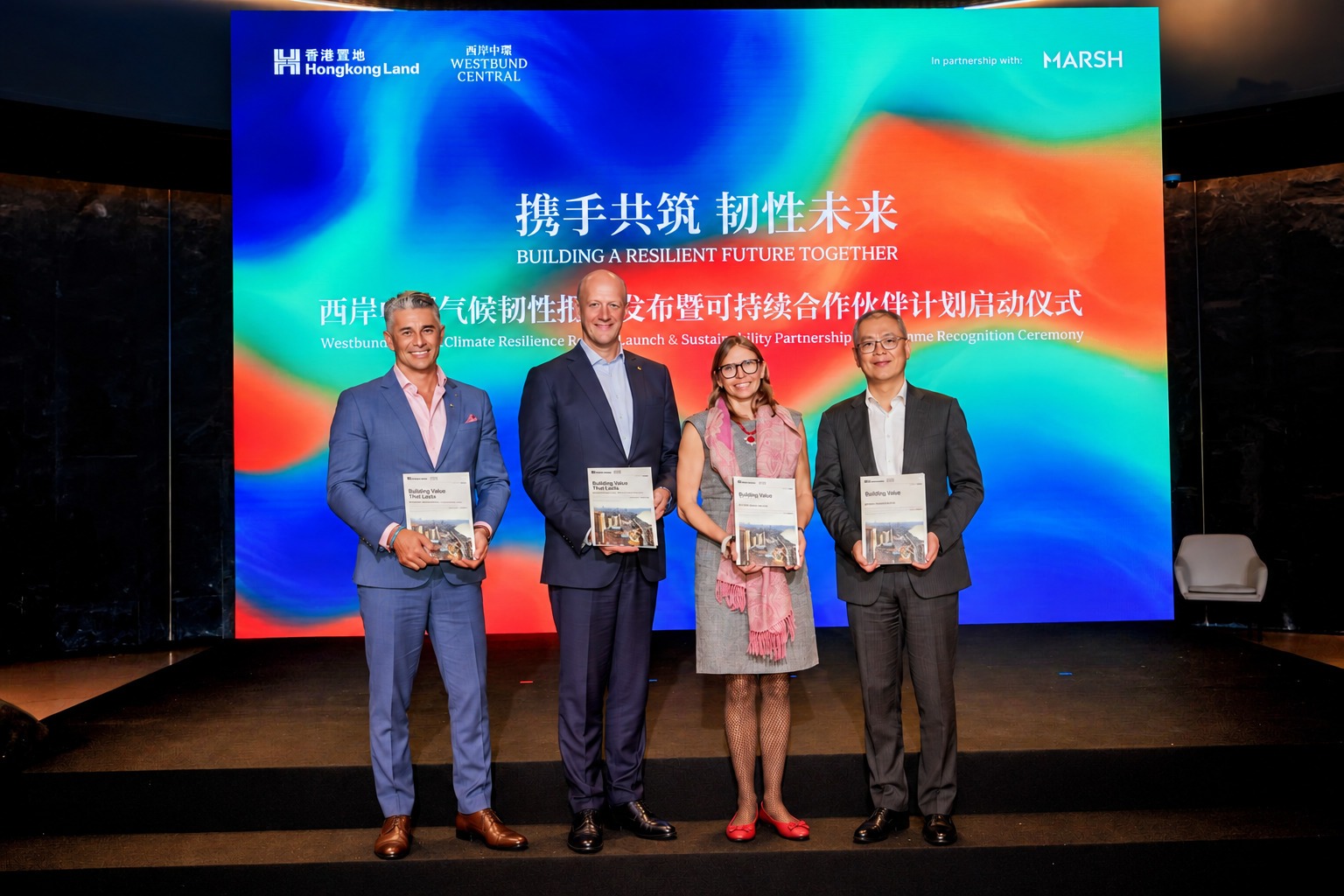
Climate resilient building design could sharply reduce damage from floods and storms, according to a new report by Hongkong Land and Marsh. The study found that special measures at a major development in Shanghai could cut expected losses from rainfall flooding by 88% under current climate conditions.
The report, published on October 23, 2026, looks at how developers can measure the financial value of climate protection. It uses Westbund Central, a large waterfront project on Shanghai’s Huangpu River, as a case study.
The findings suggest that investing in protection early can help property owners reduce damage and manage future risks. The report also says these steps may help buildings stay open during severe weather and support long-term business growth.
Westbund Central covers about 1.7 million square metres. The mixed-use project includes shops, offices, homes, hotels and cultural spaces. It is Hongkong Land’s largest single investment, with a planned value of about $8 billion.
The report found that the site’s protection measures cut expected losses from storm surges by 84% under current conditions. They also cut expected losses from rainfall flooding by 88%. The study says these measures are designed to keep future losses in 2050 below the level an unprotected building would face today.
Hongkong Land and Marsh assessed the expected yearly cost of physical damage from storm surges, rainfall floods and strong winds. This measure is known as average annual loss, or AAL. It helps property owners estimate the financial impact of climate risks over time.
The study compared buildings with added protection against those without measures beyond standard building rules. It also examined risks in 2050 under a scenario where global greenhouse gas emissions remain high.
Without added protection, expected storm-surge losses at the site would more than double by 2050. Wind-related losses would more than triple. The findings show how climate change could raise the cost of damage to buildings and infrastructure.
The report estimates that storm-surge losses would be 84% lower with the protection measures in place, both today and in 2050. Rainfall-flood losses would be 88% lower today and 79% lower in 2050. Wind losses would fall by 36% today and 31% in 2050.
The study also compared expected losses at Westbund Central in 2050 with those at an unprotected building today. For storm surges, average annual losses at the protected site are projected to reach 0.12% of the value at risk in 2050. The figure for an unprotected building today is 0.38%.
For rainfall flooding, the protected site’s expected annual losses in 2050 are projected at 0.05%. An unprotected building today would face a projected rate of 0.19%. These figures suggest that early planning can help reduce future exposure to climate damage.
Westbund Central includes several features to limit the effects of severe weather. Its drainage system has 23% more capacity and is designed to handle a rainfall event expected once in 100 years. Its basements have top-grade waterproofing, while key equipment is placed at higher levels to reduce flood risks.
The site also uses a system known as a Sponge City network. It has more than 12 features designed to capture and store rainwater. Together, these features can hold more than 2,000 cubic metres of water.
The report’s figures cover physical damage only. They do not include the cost of extreme heat, which is described as the fastest-growing climate hazard at the site. Hongkong Land manages this risk through building design and daily operations.
Michael T. Smith, group chief executive of Hongkong Land, said climate change was reshaping the property sector. He said the report shows that the financial return from climate protection can be measured with tools already available.
Stuart Grant, chief executive of Westbund Central, said many of the site’s protection measures were designed to remain out of sight. Their value becomes clear when bad weather does not disrupt tenants, visitors or business activity.
Michael Li, chairman and president of Marsh Risk China, said climate risks now affect company finances. He said better protection could reduce losses and improve access to capital.
The report calls on property developers to assess climate risks early, when changes are often easier and cheaper to make. It also urges them to involve insurers and lenders from the start and create shared standards to compare protection across buildings.
Westbund Central is due to open in phases through 2028. The project will include 240,000 square metres of retail space, 650,000 square metres of offices, luxury homes, two hotels and cultural venues.
The findings offer a clear message for the property industry. Climate protection can be more than a safety measure. When planned well, it can reduce financial risk, limit disruption and help buildings remain useful as weather conditions change.
