

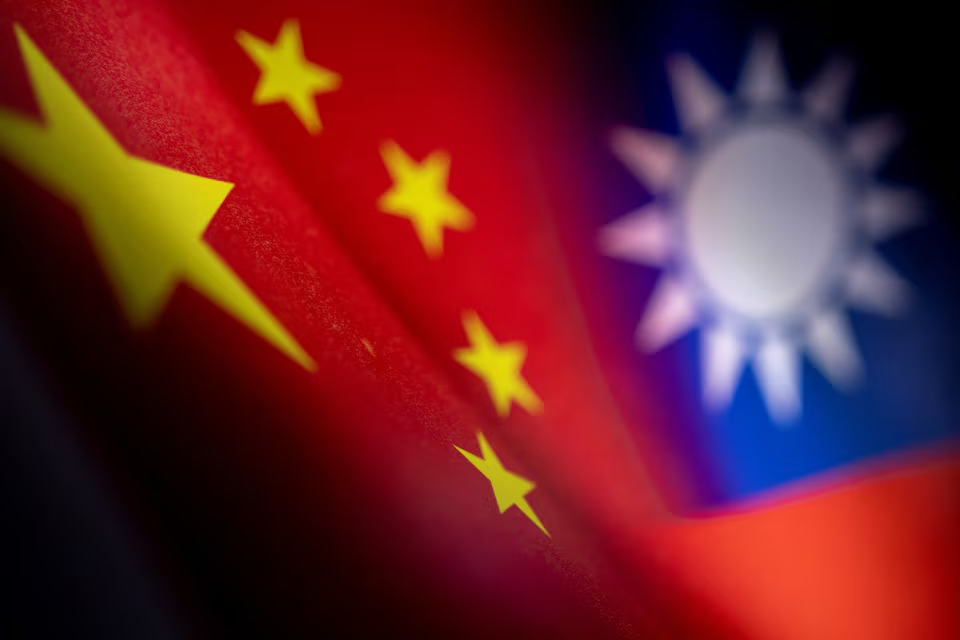
China Taiwan diplomacy is under renewed scrutiny after China’s recent engagement with Taiwan’s opposition Kuomintang (KMT), while continuing to freeze out the island’s elected Democratic Progressive Party (DPP) government. Analysts say the move reflects a calculated political strategy rather than a genuine step toward reconciliation.
The issue came into focus during KMT Chairwoman Cheng Li-wun’s visit to Beijing in April 2026. Chinese officials welcomed the delegation at high-level venues, including meetings linked to President Xi Jinping. However, Taiwan’s ruling DPP was completely excluded from any dialogue, continuing a pattern that has existed since 2016.
China cut off formal communication with the DPP after it won Taiwan’s presidential election that year. Beijing considers the party’s leadership “separatist” and refuses official contact. Instead, it maintains engagement only with political groups it views as more aligned with its position, particularly the KMT.
Observers say this selective engagement is central to China Taiwan diplomacy. Rather than negotiating with Taiwan’s government, Beijing appears to focus on opposition parties that are more open to dialogue under Beijing’s preferred political framework.
That framework is based on the “1992 Consensus,” which states there is only one China, while allowing both sides to interpret its meaning differently. Beijing insists this principle is the foundation for any cross-strait communication. During her visit, Cheng echoed this language, calling for adherence to the consensus and opposition to Taiwan independence.
Chinese leader Xi Jinping reinforced this position by making clear that political dialogue depends on acceptance of this foundation. In practice, this means engagement is conditional, and only groups that accept Beijing’s terms are included in official talks.
Critics argue that this approach turns China Taiwan diplomacy into a system of political reward and exclusion. They say it is less about mutual understanding and more about shaping Taiwan’s internal political balance by strengthening friendly voices and sidelining others.
The KMT, which governed China before 1949 and later retreated to Taiwan, has historically supported closer ties with Beijing. However, Taiwan today is a fully functioning democracy with competitive elections, a free press, and multiple political parties. The DPP, in contrast, promotes a distinct Taiwanese identity and rejects Beijing’s sovereignty claims.
Experts say this divergence makes China’s position increasingly difficult to reconcile with Taiwan’s political reality. While Beijing continues to insist on a shared “one China” framework, Taiwan operates independently with its own government institutions and democratic system.
During the visit, China announced 10 policy measures aimed at improving cross-strait exchanges. These included resuming some tourism from mainland Chinese cities to Taiwan, restoring passenger flights, and easing import restrictions on Taiwanese seafood products.
Beijing presented these steps as goodwill gestures. However, Taiwan’s Mainland Affairs Council described them as politically conditional and unstable. Officials warned that similar measures in the past have been introduced and later withdrawn without warning, creating uncertainty for businesses and communities.
This pattern has reinforced skepticism in Taiwan about China Taiwan diplomacy efforts. Many policymakers argue that economic incentives are being used as leverage rather than as stable cooperation tools.
At the same time, China maintains its long-term goal of “peaceful reunification” under a “one country, two systems” model. This approach was previously applied in Hong Kong but has faced strong criticism after political freedoms there were significantly reduced in recent years.
The KMT’s engagement with Beijing comes at a sensitive time. Concerns in Taiwan about US security commitments have grown due to mixed political signals from Washington. Some analysts believe this uncertainty is pushing opposition groups to advocate for maintaining open channels with China.
However, public opinion in Taiwan remains cautious. Polls suggest the KMT has limited support, and many citizens remain wary of any arrangement that could compromise Taiwan’s political autonomy.
Officials from Taiwan’s Presidential Office have stressed that cross-strait communication should not be tied to political conditions. They also warned against using such visits for domestic political advantage.
The broader concern raised by analysts is that China Taiwan diplomacy is increasingly shaped by symbolic gestures and selective engagement rather than equal negotiation. While economic measures may appear positive on the surface, critics say they are tied to long-term political objectives.
For now, the KMT visit highlights the complexity of cross-strait relations. It shows how diplomacy, economic policy, and domestic politics are tightly linked, and how each side interprets engagement through very different political goals.
