

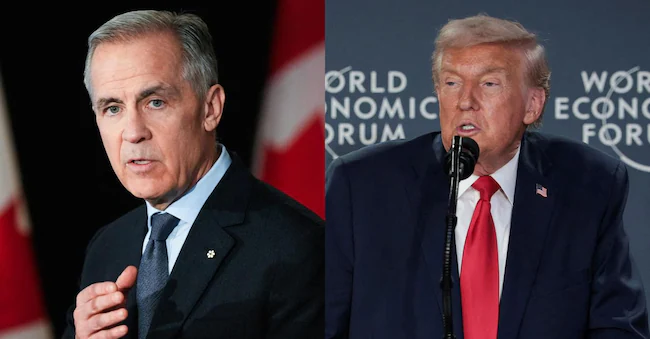
US President Donald Trump has threatened Canada with severe economic retaliation. He said the United States would impose 100% tariffs on Canadian goods. Trump issued the warning on his social media platform. He said the tariffs would take effect immediately. The threat focused on any trade engagement between Canada and China.
Trump said Canada would face punishment if it advanced a deal with Beijing. He said the tariffs would apply to all Canadian products entering the United States. He described the move as necessary to protect American interests. He did not outline any exemptions. The statement increased pressure on Canada’s leadership.
Trump Fails to Clarify Alleged Agreement
Trump did not explain which deal prompted his comments. His post broadly referenced cooperation with China. Canadian officials have not announced a free trade agreement. The lack of detail created uncertainty. Analysts questioned the basis of the warning.
Last week, Canadian Prime Minister Mark Carney announced a strategic partnership with China. The announcement included plans to reduce several tariffs. Canadian officials described the move as targeted. They avoided calling it a comprehensive trade pact. The agreement focused on resolving specific trade issues.
Diplomatic Tensions Rise After Global Forum Speech
Trump initially reacted positively to Canada’s announcement. He publicly called the development a good thing. His tone changed days later. The shift followed remarks by Carney in Davos. Those comments strained relations.
Carney said the US-led global order had been ruptured. He urged middle powers to cooperate against economic coercion. He did not mention Trump by name. The remarks drew attention in Washington. Officials viewed them as a challenge.
Trump Responds With Sharp Rhetoric and Actions
Trump responded the next day during a public speech. He said Canada survives because of the United States. The comment reflected his confrontational approach. It also sparked criticism in Canada. Diplomatic strain intensified.
Trump later withdrew an invitation for Canada. He removed the country from his proposed Board of Peace. The move signaled worsening relations. Observers saw the decision as symbolic. It highlighted growing tension.
Claims of Canada Acting as China’s Trade Gateway
Trump escalated his criticism in another social media post. He accused Canada of acting as a drop-off port for China. He claimed Chinese goods would enter the United States through Canada. He rejected the idea strongly. He repeated his tariff threat.
He warned that Canada would not serve as a gateway. He said Canadian leaders misunderstood his position. The remarks increased uncertainty for businesses. Trade groups monitored developments closely.
Canadian Government Rejects Free Trade Deal Claims
Canada’s trade minister Dominic LeBlanc rejected Trump’s claims. He said Canada was not pursuing a free trade agreement with China. He said officials resolved several important tariff issues. He emphasized economic stability and cooperation.
LeBlanc said the government focused on strengthening Canada’s economy. He said officials aimed to expand trade partnerships worldwide. He highlighted diversification beyond the United States. The US remains Canada’s largest trading partner.
Canada Accelerates Trade Diversification Efforts
Canada has sought to reduce reliance on the US market. Trump’s unpredictable tariff policies accelerated that strategy. Ottawa expanded outreach to other economies. Officials described diversification as essential. The China agreement reflects that approach.
Under the agreement, China will cut tariffs on Canadian canola oil. The rate will fall from 85% to 15% by March. Canada will lower tariffs on Chinese electric vehicles. The rate will drop to 6.1%.
Deal Marks Shift in Canada–China Relations
The agreement followed years of strained relations. Both countries previously imposed retaliatory tariffs. Analysts described the deal as a breakthrough. It could lead to increased Chinese investment. It may also stabilize bilateral trade.
Carney said the progress positioned Canada well. He said the country must adapt to global change. He framed the deal as strategic preparation. He described the moment as part of a new world order.
