

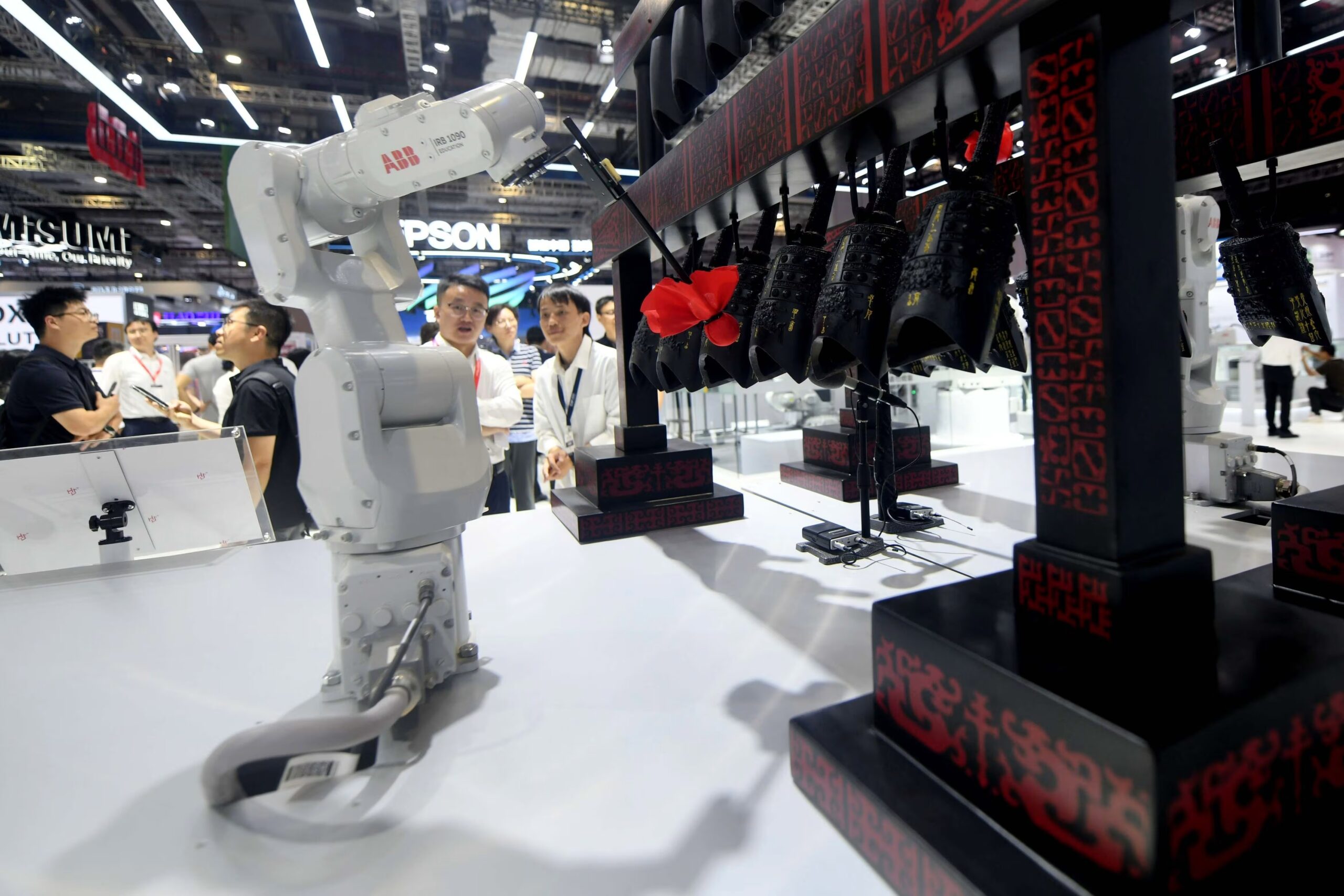
China has reportedly blocked SoftBank’s planned $5.4bn purchase of ABB’s robotics division. The decision threatens to disrupt one of the biggest parts of Japanese billionaire Masayoshi Son’s strategy to expand into physical artificial intelligence.
Several people familiar with the matter said SoftBank was recently informed that China would not approve the transaction. The decision came from the National Development and Reform Commission, or NDRC, a powerful government body responsible for economic planning and protecting the country’s strategic supply chains.
The move surprised people close to the Japanese technology group. Until recently, many expected the acquisition to receive approval. The deal had already passed China’s competition review in February and was undergoing a separate security assessment.
SoftBank is now trying to understand why regulators rejected the transaction. The company is also considering whether it can submit a new application and seek approval under different conditions.
China is a major part of the appeal of ABB’s robotics business. The country is the largest market for the division, and more than 90 per cent of the robots it sells to Chinese customers are produced locally. ABB also employs around 12,700 people in China.
The scale of those operations made the division particularly valuable to SoftBank. The Japanese group wanted to use the business as a foundation for its plans in industrial robotics and physical AI.
However, Beijing’s review reportedly raised concerns about the future of the Chinese operations. People familiar with the process said regulators examined ABB’s local supply chains in detail. They also wanted assurances that important manufacturing capabilities would remain inside China.
Another concern involved the movement of technology and data beyond the country. Regulators reportedly feared that information generated by robotics operations in China could be transferred overseas and used to train artificial intelligence systems.
That concern may have been especially important because SoftBank is a major investor in OpenAI. People familiar with the review said Chinese officials were worried that robotics data could eventually support AI models developed outside the country.
The review also examined the ownership of intellectual property linked to parts of ABB’s robotics business. According to people briefed on the discussions, regulators considered whether some assets should remain under Chinese control.
One possible condition involved separating parts of the business and transferring them to Chinese owners. Such a restructuring could have allowed the wider acquisition to move forward. However, people close to SoftBank said there was uncertainty in Japan about which conditions Chinese authorities were formally seeking before the decision was made.
The planned acquisition was agreed last October. It formed part of Son’s broader effort to position SoftBank for what he believes will be a major expansion in AI-powered machines and automated systems.
Son has increasingly focused on physical AI, which combines artificial intelligence with robots and machines that can perform tasks in the real world. The technology could transform manufacturing, logistics, security and other industries.
ABB’s robotics division was expected to play a central role in that strategy. SoftBank also planned to build on its investment in the US AI and robotics company Roze.
The setback comes as China and Japan face strained relations. Beijing has become increasingly cautious about the transfer of sensitive technology and industrial assets to foreign companies. Strategic competition between China and the United States has also increased pressure on Chinese regulators to protect domestic capabilities.
ABB has operated in China for decades. The Swiss-Swedish company established a joint venture with a Chinese partner in 1992. Its robotics operations later became an important part of its presence in the country.
Shanghai authorities also supported the development of ABB’s large robotics factory in the Pudong district. The $150mn facility began operations in 2022 and strengthened the company’s local manufacturing capacity.
For China, keeping production, technical knowledge and related data within the country appears to have been a central issue in the review.
SoftBank and ABB declined to comment on the reported decision.
The acquisition was also intended to support Son’s wider ambitions beyond factory automation. He is reportedly in talks to acquire Allied Universal, the world’s largest private security company and the owner of British security group G4S.
The proposed investment could give SoftBank another route to introduce robotics and AI into large-scale business operations. Automated systems could help security companies improve productivity and reduce the need for some manual tasks.
However, the Chinese decision creates fresh uncertainty for SoftBank’s physical AI plans. Losing access to ABB’s robotics division would remove a major industrial platform from the strategy.
The outcome may also show how national security concerns are becoming more important in cross-border technology deals. Even when a transaction clears competition checks, governments can still block it over concerns about data, intellectual property and control of important manufacturing assets.
