

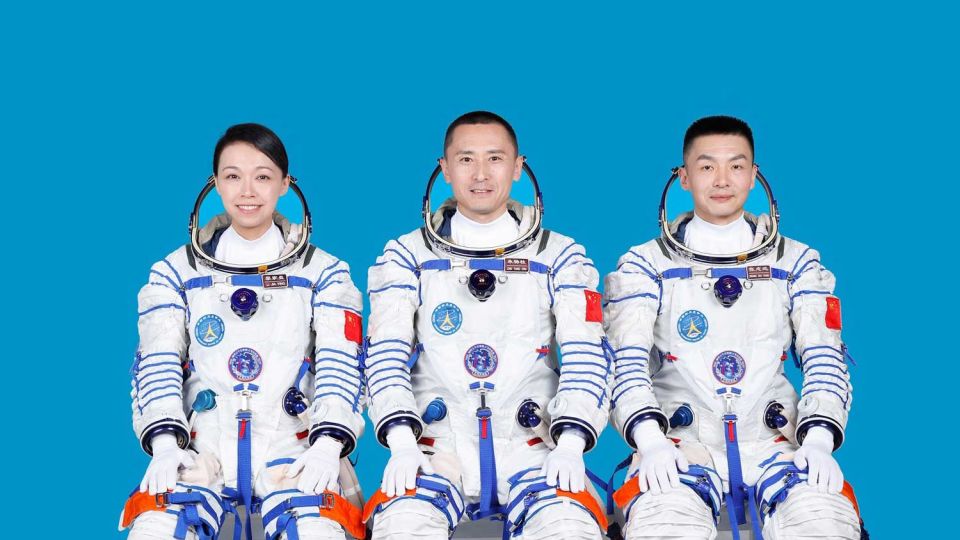
China is preparing to send a new crew to its space station in a major step for its human space program. The Shenzhou XXIII mission is set to launch late on Sunday night from the Jiuquan Satellite Launch Center in northwest China. The mission will carry three astronauts to the Tiangong space station, which orbits Earth at about 400 kilometers above the planet.
The launch will use a Long March 2F carrier rocket. The rocket is scheduled to lift off at 11:08 pm local time. Engineers are completing final checks and fuel preparations at the launch site. Officials say all systems are moving toward a safe and planned liftoff. The China Manned Space Agency is leading the mission and overseeing all technical work and safety steps.
The crew includes mission commander and spaceflight engineer Colonel Zhu Yangzhu, spacecraft pilot Colonel Zhang Zhiyuan, and science payload specialist Lai Ka-ying. Lai is gaining global attention as she is set to become the first astronaut from Hong Kong to travel into orbit. She is also the first female civilian astronaut in China to reach space.
Lai Ka-ying currently works as a superintendent and technical specialist with the Hong Kong Police Force. Her selection marks a rare move toward including more civilian professionals in China’s astronaut program. Before her, only military personnel and trained pilots from the armed forces had reached space in China’s manned missions.
The inclusion of Lai also marks another milestone for women in China’s space program. Earlier female astronauts, including Liu Yang, Wang Yaping, and Wang Haoze, all came from military backgrounds. Lai’s mission now expands that history by bringing a civilian role into orbit for the first time.
The China Manned Space Agency said the Shenzhou XXIII mission will focus on both science and station operations. The astronauts will carry out maintenance work on the Tiangong space station. They will also conduct scientific experiments in microgravity. These studies are expected to support long-term space research in areas such as biology, materials science, and space technology.
The crew will also perform spacewalks. These walks will be used to install new equipment and retrieve scientific tools outside the station. In addition, the astronauts will take part in education activities. These programs aim to connect students on Earth with real-time space science and inspire interest in space exploration.
Officials confirmed that the Long March 2F rocket’s propellant loading will begin shortly before launch. Engineers are working around the clock to prepare the service tower and surrounding systems. Safety teams are monitoring weather conditions and technical readings to ensure a stable launch window.
The Shenzhou XXIII mission will be China’s 17th human spaceflight mission. It will also be the 11th crewed mission to the Tiangong space station. The station continues to grow as a key part of China’s long-term space plan. It is currently home to the Shenzhou XXI crew, who arrived earlier in November and are expected to return to Earth later this month after completing their rotation.
The current crew includes mission commander Senior Colonel Zhang Lu, spaceflight engineer Major Wu Fei, and payload specialist Zhang Hongzhang. Their work has helped prepare the station for the arrival of the new team. Once Shenzhou XXIII docks, both crews will briefly work together to transfer responsibilities and maintain continuous operation of the station.
The launch is seen as an important step in China’s growing space program. It shows continued progress in crewed space missions and long-term station use. It also highlights the increasing role of civilian experts and regional representation in national space efforts.
As the countdown continues, attention is focused on the Jiuquan launch site. Engineers, astronauts, and mission controllers are preparing for a carefully timed launch that will send the new crew toward orbit and begin another chapter in China’s space exploration journey.
