

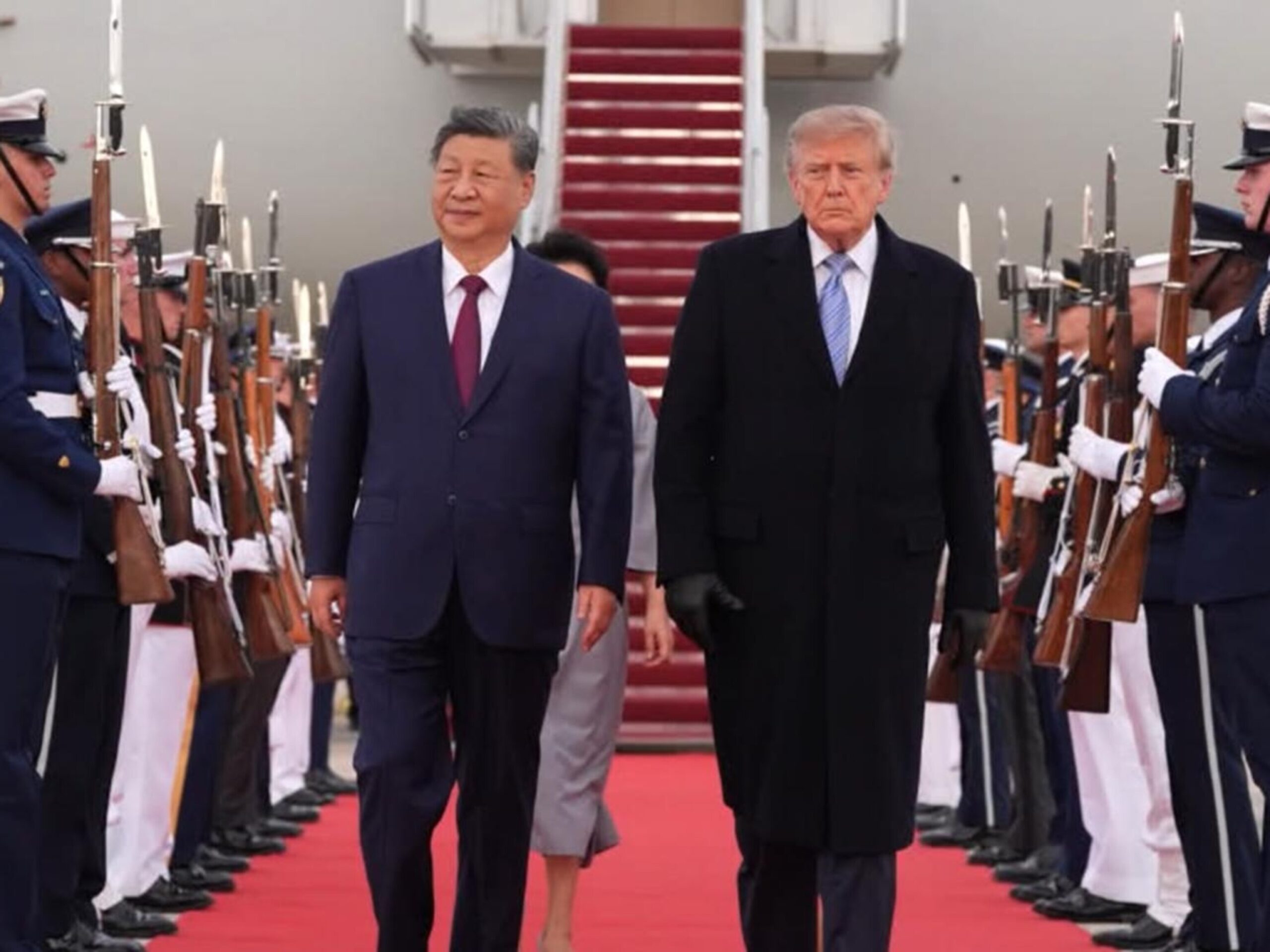
US President Donald Trump welcomed Chinese President Xi Jinping to the United States on Wednesday for a three-day visit focused on key global issues. The leaders are expected to discuss trade, artificial intelligence safety, Taiwan, the war in Iran, and critical minerals.
Trump and First Lady Melania Trump greeted Xi and his wife, Peng Liyuan, at Joint Base Andrews in Maryland on September 23. The arrival ceremony featured a red carpet, military personnel, music, and a flyover by two B1 bombers.
The welcome marked an unusual move by Trump, who often receives foreign leaders at the White House. The visit comes as Washington and Beijing seek to manage trade tensions and discuss several areas of disagreement.
The two leaders did not make public remarks during the airport ceremony. They exchanged greetings with their spouses before Xi and Peng left in their vehicle.
A key development emerged later on Wednesday when US Treasury Secretary Scott Bessent said the two countries had agreed to extend their trade truce until January 10.
The agreement, known as the Busan Agreement, had been due to end on November 10. Bessent said the extension would give both sides more time to discuss economic issues and work towards further progress.
Speaking to reporters, Bessent said it remained unclear whether the two countries could reach a broader deal. He said the United States would consider whether to extend the current agreement or seek a wider arrangement.
Bessent also said some commitments made by China had not been fully met. He added that Washington wanted to see stronger efforts from Beijing to carry out the existing terms over the coming months.
The extension offers both governments more time to address trade concerns. However, major questions remain about the next stage of their economic relationship.
Trump said he planned to discuss Iran with Xi during the visit. When reporters asked whether the subject would feature in their talks, Trump said it would be among several issues under discussion.
The war in Iran adds another concern to an already complex relationship between Washington and Beijing. Trade, Taiwan, artificial intelligence, and access to critical minerals are also expected to feature in the discussions.
The leaders face pressure to manage their differences while keeping communication open. Their talks could help clarify where the two governments may find common ground and where disagreements remain.
No detailed account of their private discussions was available at the time of the arrival ceremony.
Trump and Melania Trump were scheduled to welcome Xi and Peng at a formal ceremony at the White House on Thursday.
The program was set to include a review of troops in the Rose Garden before the leaders moved into private talks. Later, Trump and the first lady were due to host Xi and the Chinese delegation at a state dinner in the East Room.
The dinner guest list included several major figures from the technology and business sectors. Those expected to attend included Amazon founder Jeff Bezos, Tesla and SpaceX chief Elon Musk, Meta chief Mark Zuckerberg, Google chief Sundar Pichai, and Dell Technologies chief Michael Dell.
Other expected guests included Nvidia chief Jensen Huang, OpenAI chief Sam Altman, Citigroup chief Jane Fraser, and Tim Cook, who had recently stepped down as Apple’s chief executive.
The presence of technology leaders reflects the growing importance of artificial intelligence and advanced technology in US-China relations. Both countries have economic and security interests tied to these sectors.
On Friday, Xi and Peng were scheduled to meet Trump and Melania for private tea and visit the National Archives. The planned tour would include historical national documents before the Chinese president departed the United States later that day.
Xi last made a state visit to the United States in September 2015, during Barack Obama’s presidency. Trump visited China in May for talks with Xi.
The latest visit offers both leaders another chance to discuss trade and wider global concerns. The extension of the trade truce provides more time for negotiations, but it does not resolve the main disputes between the two countries.
The outcome of the summit will depend on whether both sides can turn their talks into practical steps on trade and other shared concerns.
