

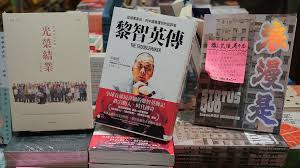
Hong Kong police have reportedly arrested a bookstore owner and three staff members for allegedly selling publications deemed “seditious,” including a biography of jailed pro-democracy activist and publisher Jimmy Lai. The owner of Book Punch, Pong Yat-ming, and three employees were accused by broadcaster TVB of selling copies of “The Troublemaker,” a biography of Lai penned by his former business director, Mark Clifford. The bookstore displayed a notice citing an “emergency” for its temporary closure, and Reuters could not immediately confirm charges. This incident marks a significant escalation in the city’s ongoing crackdown on dissent, targeting not just media outlets but also those involved in distributing related literature.
Jimmy Lai, founder of the now-shuttered Apple Daily newspaper, was recently sentenced to a 20-year jail term for collusion with foreign forces and sedition under the city’s sweeping national security laws. The laws, imposed by Beijing in 2020 and supplemented by local legislation known as Article 23, aim to restore stability after 2019 pro-democracy protests. Sedition carries a penalty of up to seven years in jail, potentially extending to ten years if external collusion is involved, underscoring the severe legal repercussions faced by individuals accused under these statutes.
The arrests have drawn sharp international criticism and concern. Mark Clifford, the book’s author, now based in New York, expressed his dismay, calling it “a sad and ironic commentary that selling a book on a man who is in jail for his activities as a journalist, for promoting free expression, would be subject to sedition.” Elaine Pearson, Asia director at Human Rights Watch, characterized the situation as “increasingly dystopian,” warning that the authorities’ “insatiable drive for political security will only create more insecurity for itself” and questioning who might be targeted next.
The incident further highlights a broader tightening of controls over information and expression in Hong Kong. Just prior to these arrests, the city government gazetted new amendments to the national security law’s implementation rules. These changes empower customs officers to seize items deemed to possess “seditious intention” and allow police, with a magistrate’s warrant, to demand mobile phone or computer passwords from suspects, with non-compliance carrying penalties of jail time and fines. These moves indicate an expanding scope of enforcement, extending far beyond direct political activism to encompass cultural and informational spheres.
