

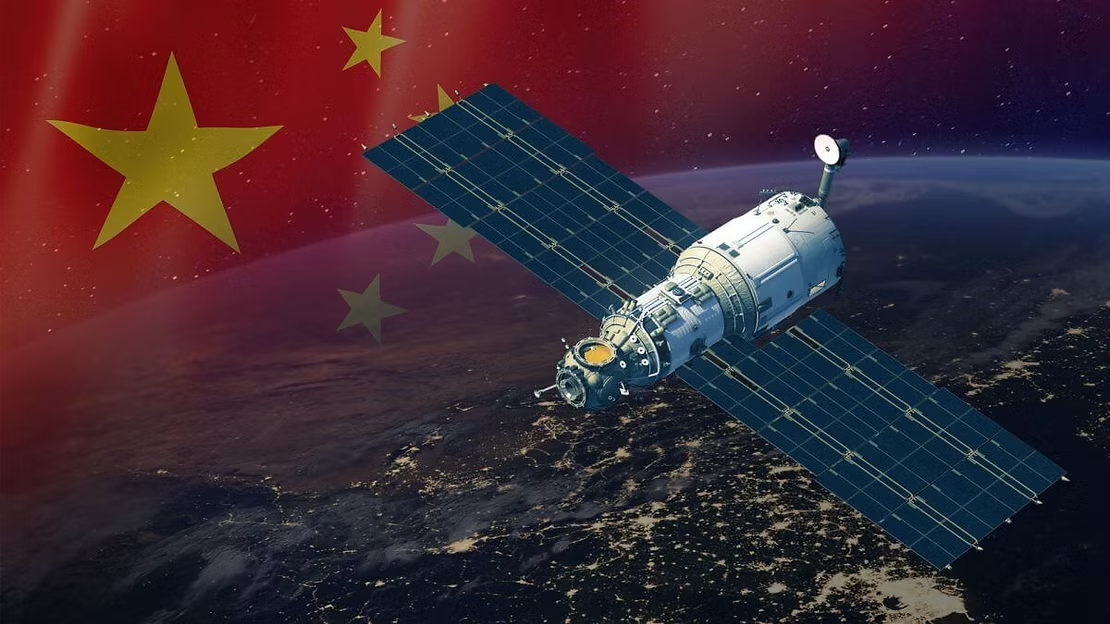
China’s national space science center announced that several of its space science satellites have achieved major breakthroughs in frontier areas of space research. The satellites include “悟空号” (Wukong), “慧眼号” (Insight), “夸父一号” (Kuafu-1), and others.
The satellites have contributed to new understanding in cosmic ray propagation, solar eruptions, and other key space phenomena. Researchers said the data collected will help advance knowledge of the universe and improve space weather prediction.
“悟空号” has been tracking cosmic rays and measuring their interactions with the Earth’s magnetic field. These observations provide important information about high-energy particles that originate from deep space.
“慧眼号” has focused on solar activity, capturing detailed information on solar eruptions and coronal mass ejections. Scientists said the data could enhance the forecasting of solar storms that affect satellites, communication systems, and power grids on Earth.
“夸父一号” is designed to study extreme space environments and test new technologies for deep-space observation. Early results suggest significant advances in monitoring solar and cosmic phenomena.
Experts said these breakthroughs reflect China’s growing capabilities in space science. The satellites’ findings are expected to contribute to international research on cosmic rays, solar physics, and space weather forecasting.
The national space science center emphasized that continued satellite missions will expand knowledge in high-energy astrophysics and planetary science. Future missions aim to further explore solar activity, cosmic radiation, and the dynamics of the Earth–Sun system.
China’s space scientists noted that the satellites are equipped with advanced detectors and instruments capable of collecting high-precision data. These tools allow researchers to study phenomena that were previously difficult to observe in detail.
The breakthroughs also have practical applications. Improved understanding of cosmic rays and solar eruptions can help protect satellites, spacecraft, and terrestrial technology from the impacts of extreme space weather.
International space observers acknowledged China’s progress, saying these missions demonstrate the country’s commitment to advancing scientific knowledge and contributing to global space research.
Researchers added that the satellites’ ongoing operations will continue to yield valuable data for years to come. The missions are part of a broader effort to build China’s expertise in space science and expand its presence in space exploration.
The announcement follows several years of investment in space technology, satellite development, and advanced research capabilities. China’s space program aims to maintain a leading role in both applied and fundamental space science.
By achieving these breakthroughs, China’s satellites are not only expanding human knowledge of the cosmos but also strengthening technological innovation in observation and measurement techniques.
Scientists said that collaboration and data sharing with international research institutions could maximize the impact of the discoveries. The insights gained from these satellites are expected to influence studies in astrophysics, heliophysics, and planetary science worldwide.
China’s national space science center confirmed that further satellite missions are planned to explore uncharted areas of the solar system and beyond, ensuring continuous progress in high-precision space research.
