

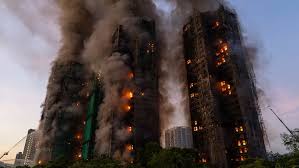
Public hearings have officially commenced in Hong Kong regarding the catastrophic Wang Fuk Court apartment fire, a devastating blaze that tragically claimed 168 lives last year. A judge-led independent committee has been established to meticulously investigate the incident, with a broad mandate to scrutinize various contributing factors. The committee’s primary objectives include determining whether existing fire safety standards were inadequate, if construction practices played a role in the fire’s rapid escalation, and if any failures occurred on the part of government officials or contractors. This inquiry aims to provide clarity and accountability. Former resident Yip Ka-kui, who lost his wife and home, expressed a profound desire for “justice for the deceased and an explanation for the victims,” underscoring the high emotional toll and public expectation for transparency.
The fire, which erupted on November 26 at Wang Fuk Court, a high-rise complex in the Tai Po district, stands as the world’s deadliest residential building fire since 1980. The disaster engulfed seven out of eight residential towers. A significant concern under investigation is the role of ongoing renovations; the affected buildings were notably covered in bamboo scaffolding, protective netting, and foam boards. Experts believe these materials may have acted as accelerators, significantly contributing to the fire’s rapid and devastating spread. The committee will delve into how these common construction elements might have compromised fire containment and evacuation efforts, exacerbating the tragedy. Understanding these dynamics is crucial for preventing similar incidents in future urban development projects.
Beyond the immediate causes, the independent committee’s scope extends to uncovering potentially deeper, systemic issues within Hong Kong’s construction and governance sectors. Its website explicitly states an intent to determine if “undue connected interests, conflicts of roles, or improper collusion” were present. Furthermore, the investigation will probe “whether bid-rigging corruption, or irregularities were involved in the tendering process of these works.” This broad inquiry into potential malfeasance suggests that the tragedy might stem from more than just accidental failures, hinting at possible unethical or illegal practices. Expected witnesses include government officials, former residents, directors of construction firms, and members of the Wang Fuk Court management committee, ensuring a comprehensive examination.
In parallel with the public hearings, multiple other investigations are actively underway. The Hong Kong police force is conducting a separate criminal investigation, which has already led to the arrest of 38 individuals on suspicion of manslaughter, with an additional six apprehended for fraud. Furthermore, the Independent Commission Against Corruption (ICAC) has also made significant arrests. The ICAC confirmed the apprehension of 23 individuals, including consultants, contractors, and members of the owners’ corporation of the complex. These parallel investigations underscore the gravity and complexity of the Wang Fuk Court fire, aiming to uncover both the immediate causes and any underlying criminal or corrupt practices that may have contributed to this horrific tragedy.
