

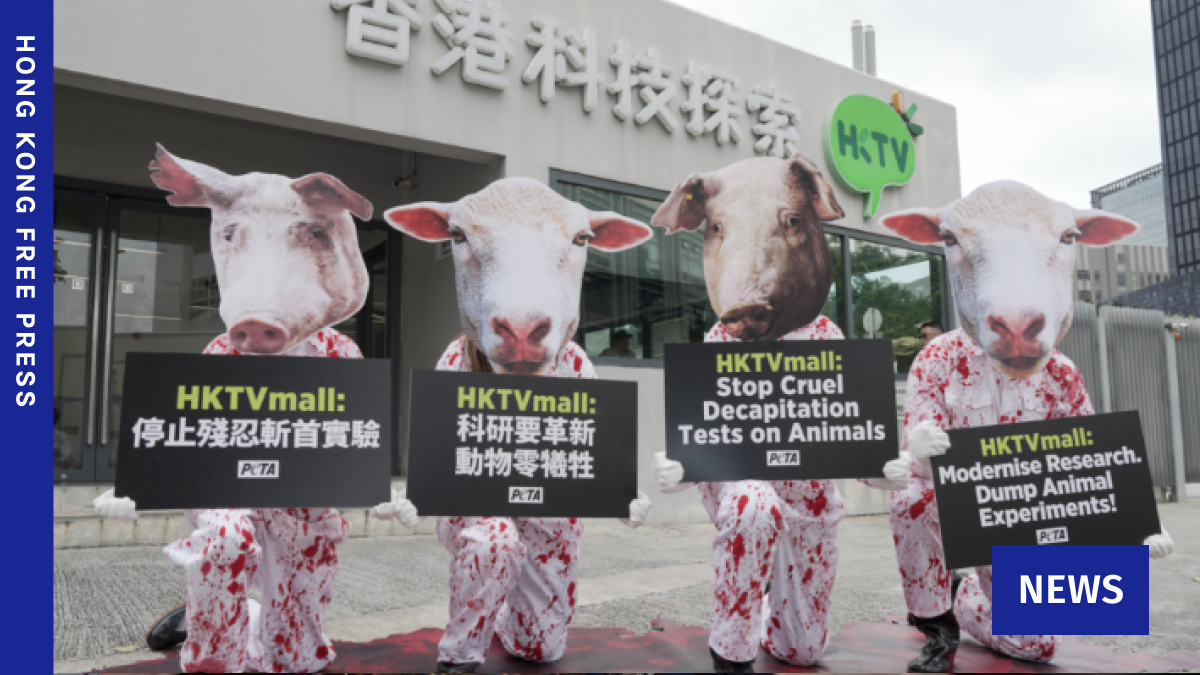
PETA Asia has staged a dramatic protest outside Hong Kong Technology Venture Company (HKTV) headquarters, condemning the “horrific experiments” revealed in HKTV’s recent annual report. Four PETA Asia supporters donned pig and sheep costumes, mock-bloodied, to highlight what they describe as the decapitation and dismemberment of dozens of animals, kept alive for up to seven hours. The protest specifically targeted HKTVmall, the e-commerce arm of HKTV, urging consumers to boycott the platform until the practices cease. This highly visible demonstration in Tseung Kwan O aimed to draw public attention to the controversial research and pressure HKTV to halt its Life Science Project.
HKTV’s annual report, published on March 30, detailed 38 experiments conducted over the past four years where “animals’ limbs or heads were separated from their bodies.” These tests, part of an ongoing “Life Science Project,” are designed to develop equipment capable of maintaining “the viability of detached body organs.” The company claimed remarkable success, stating that animal limbs remained viable for approximately 46 hours and heads for roughly seven hours, a feat its research team asserted was a world first. While HKTV suggests potential applications in organ transplantation and extending human lifespan, it acknowledged uncertainty regarding the project’s success rate or financial return.
PETA Asia President Jason Baker vehemently criticized the experiments, calling them “straight out of a horror film” and demanding their immediate cessation. Baker highlighted PETA’s stance that animal experiments largely fail to benefit human health due to fundamental interspecies differences, citing studies on spinal cord injury research. He also pointed out a global shift away from animal testing by prominent US agencies, favoring “human-relevant technologies” such as non-invasive human imaging. PETA’s call for a boycott of HKTVmall underscores their commitment to ending what they view as extreme cruelty and advocating for ethical alternatives in scientific research.
In response to HKFP inquiries, HKTV defended its Life Science Project, stating it was “not intended to cause unnecessary harm to the animals” but aimed at improving the quality of life for the elderly and advancing organ preservation, limb transplantation, and blood regeneration. The company confirmed that pigs and sheep, commonly used in organ transplantation research, were subjected to anaesthetics during the procedures, which HKTV claims comply with government regulations on laboratory animal ethics. HKTV emphasized that its research team comprises professionals like neurosurgeons and veterinarians, and that alternative experimental methods had proven ineffective. The company, however, did not disclose the names of the team members involved.
